


Housekeeping
Welcome to all our new Spanish-speaking subscribers, many of whom seem to have arrived via Karen Sichel, who can be found here. Although we’re quite linguistically proficient around here, those languages do not include Spanish, alas—apologies in advance.
Helen has also made use of insights from our paid subscriber chat in this piece on Epstein and British politics (for Law & Liberty). Your thoughtful remarks are greatly appreciated.
One of the things economists rarely consider is different societies’ immigrant absorption capacity. They would say of economies rather than of societies, and that is part of the problem.
By absorption capacity, I mean the capacity to absorb immigrants with the least damage to institutions and its citizens’ and residents’ quality of life. One of the reasons why this is rarely considered is because immigrants are treated as not varying in any way that matters—that immigrants can be just assessed as a single analytical category. Another reason is immigrants are treated as the only humans in history who cannot make things worse. A third reason is that commerce is treated as if it is the only relevant mechanism of cooperation, that the other mechanisms of cooperation in making a successful society need not be considered.
All these claims or presumptions are false.
Conventional centre-right politicians have, again and again, taken their cue from economists and treated immigration as an economic issue—when it is so much a cultural one. This is why such politicians have, again and again, proved to be incompetent at cultural politics and been pushed aside by national populists. It is how country-club Republicans got Trumped, Gaullists got Le Penned, Forza Italia got Melonied, the Tories are being Faraged, and now the Coalition in Australia is getting Hansoned.
The last is happening because the ALP Federal Government has pushed Australia to the wrong side of its immigrant absorption capacity. Yes, the Bondi Massacre was a galvanising shock, but that voters were beginning to arc up was already clear. Even Australia has limits.
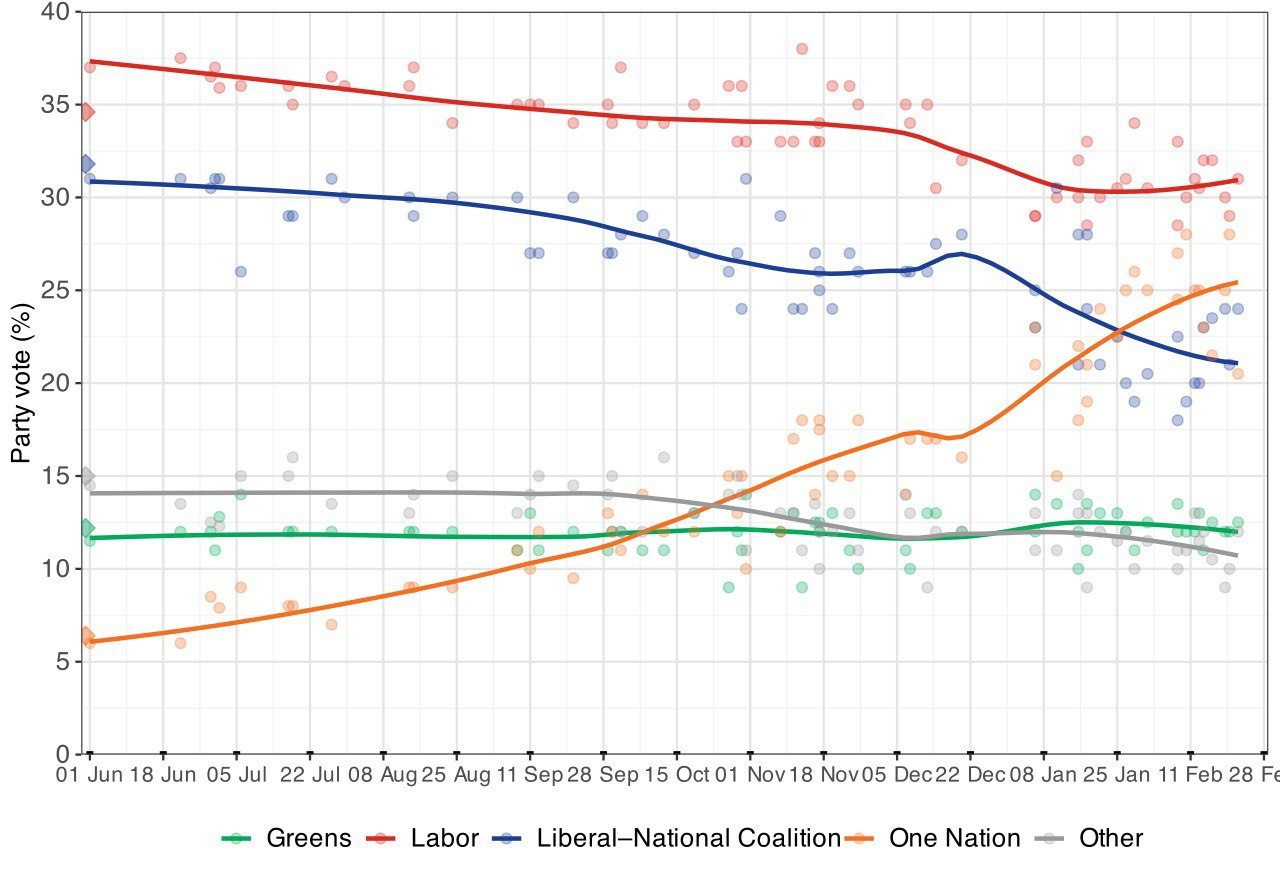
The Liberal-National Party Coalition screwed up its response both to the Bondi Massacre and to PM Albanese’s response, one that had already alienated the wider public (this is why both major parties experienced a polling dip). They did so in the standard way conventional centre-right politicians have been doing for years: they failed to grasp the cultural politics. (No centre-right party should support any form of hate speech legislation, ever: hate speech is how Marcusean repressive tolerance gets repackaged, and is used as such.)
This collapse of support for conventional centre-right politics has happened in polity after polity: Australia is merely the last and (currently) least severe. Yet, conventional centre-right politicians never seem to learn. Part of why they never learn is they take way too many cues about immigration from mainstream economists. Economists who are remarkably clueless about, for instance, limits to a nation’s capacity to absorb immigrants.
Any economist who treats immigrants as a generic group is being stupidly unobservant. If they treat immigrants as the only group of humans in history who cannot make things worse, they are engaging in ridiculous social posturing. If they do not consider civil war as a potential cost of immigration, they are being historically illiterate. If they do all three, they are a classic instance of social science making Western societies stupider. They have certainly aided conventional centre-right politicians to repeatedly fail through political and policy incompetence.
If your default view of immigration is that it is about humans, treated as interchangeable widgets (“economic agents”), moving between societies—societies that are conceived as free-floating arenas for transactions, where efficiency is overwhelmingly the dominant concern—then the immigrant absorption capacity issue seldom arises. But that is a ludicrously inadequate view of immigration, of immigrants, and of human societies.
The absorption capacity of a society depends on, among other things, its institutional structure; how robust its civic culture is; the number and characteristics—including cultural characteristics—of immigrants. A successful polity is built on the full range of cooperative mechanisms, not just commerce. The effect of immigrants—and of the number and characteristics of immigrants—has to be considered against all the cooperative mechanisms that build and sustain a successful society.
One way to ensure mass immigration becomes more fraught is to combine mass immigration with Net Zero. Net Zero means restricting access to energy and making it more expensive. Cheap energy is fundamental to mass prosperity. If you drive up energy costs while increasing the number of people seeking to use the energy you are restricting and making more expensive, you are deliberately increasing contestation over resources. This drives up the costs of immigration generally and makes mass immigration exceptionally fraught. That so many folk do not stop to wonder if there is any difficulty about combining mass immigration with Net Zero indicates how rarely absorption capacity is considered.
If infrastructure construction lags, or simply cannot fully respond to increased demand due to other constraints, there will be congestion costs from mass immigration which people will notice every working day. Competition for positional goods—or any goods where supply does not respond fully to demand—will increase. This includes political positional goods. There are constraints on the ability to absorb immigrants, even without considering cultural compatibility.
But cultural compatibility also matters. The success of what we now call Western civilisation has been built on the development of individualist cultures that enabled, and generated, a raft of successful social cooperation mechanisms. Medieval Christian societies—through their suppression of kin-groups—put the Homo sapien super-power of non-kin cooperation on steroids and so European (and neo-European) polities came to dominate the planet.
Suppressing kin-groups meant much more fluid cooperative possibilities. It also drove people to create new mechanisms for social cooperation. This gave the processes of social selection far more to work with.
The liberal individualism that so many Very Serious People—including so many economists—in the West utterly take for granted is a cultural creation. It is the creation of a particular cultural matrix. To understand this, we need to dive into the history, into comparative historical anthropology.
The rule of the clan
Across the globe, most cultures are kin-group based. The main exceptions are Christian-origin cultures, riverine SE Asian cultures, and various island cultures.
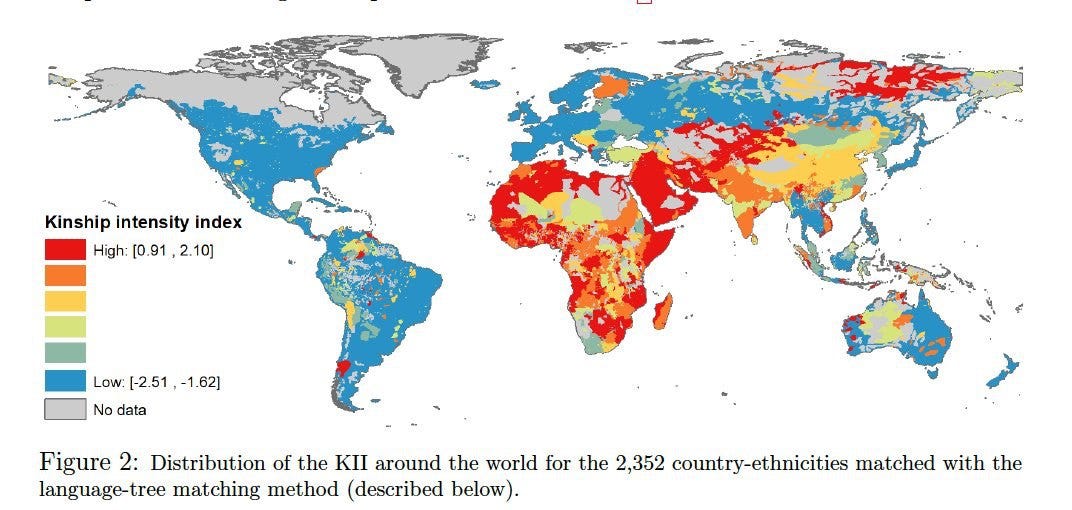
Island cultures have a natural geographic in-group—their island or islands. Their geography very much shapes cooperative opportunities in a way that encourages broad cooperativeness within each island. Narrowing your cooperation to your kin-group is not only not likely to be an advantage, it sacrifices cooperative—and especially risk-management—opportunities without commensurate benefits. You are all, literally, in this together: especially when it comes to shared disasters such as violent weather.
You see this cooperative-islanders pattern in various contexts. The Serene Republic of Venice, for example, sitting on its islands in its lagoon, was notoriously socially stable; it did not have a single significant popular revolt in its thousand year history. Again and again on islands, locality has dominated over lineage in generating cooperative and risk-management opportunities. The Moriori of the Chatham Islands provide an extreme example of islander cooperativeness.
There are obvious counter-examples—the steep mountain valleys and swamps of New Guinea, for example. The Maori after they ate the last Moa, leaving them without a good animal protein source (except each other), is another. The pastoralism of the “Celtic fringe” in the British Isles is a third. Nevertheless, the geography of islands has often meant that locality triumphs over lineage.
South-East Asia shares a feature with most island cultures—no pastoralists. Moreover, the various river valleys are small enough that there was no advantage to the riverine rulers in encouraging kin-groups to economise on administration (the Southern Chinese model, discussed in Part II).
Pastoralists
Kin-groups are powerful where they provide an advantage in social cooperation. This is strongest among pastoralist groups. Indeed, pastoralist groups are not only very strongly kin-group oriented, they are patrilineally kin-group oriented.
Animals are mobile assets. They are easily stolen and hard to defend. You cannot look after the animals while minding the kids, so the herds are typically owned by the men and passed down the male line. Hence pastoralist societies being patrilineal (family identity passed down the male line) and patrilocal (wife moves in with husband’s family, who own the assets they live off).
Moreover, warriors who grow up together, and live within dense networks of life-long connections, have very strong reasons to maintain their reputation for bravery and reliability. One YouTuber expresses this well:
15:20 As for their daily life, their customs, their practices, their religion, it was all centred around movement and the nomadic pastoralist lifestyle. They traveled in wagon homes, moving seasonally across the steppe in search of fresh pasture for their animals. And this is important because their wealth was not measured in land or in goods, so to speak. It was measured in herds.
And there’s something very important that we need to pause on here, because when your wealth is measured by your herds, the amount of animals that you have, it fundamentally changes how a society thinks morally.
Herds can be easily stolen. And that’s why in steppe societies like the Scythians, honour and integrity were hugely important for these peoples. Loyalty mattered, reputation mattered, oath-breaking and cattle rustling were seen as capital crimes, because it threatened the very survival of the group itself and the culture at large.
And Herodotus makes this very clear. Scythian justice was not harsh simply because they were cruel, but because disorder could not be tolerated in a world that literally had no boundaries.
Pastoralists consume high-protein, animal-food diets, so tend to be strong and healthy. You deter attacks on the animal herd(s) you live off by your personal reputation as a warrior and the strength of your connections to fellow warriors. Hence pastoralist societies are both warrior societies and organised by patrilineal kin-group. Ireland, the Scottish Highlands, the Balkan uplands—the regions that resisted the suppression of kin-groups in medieval Christian Europe—were all pastoralist societies.
When Genghis Khan re-arranged Mongol society to suppress kin-based feuds, he used a form of locality arranged by a decimal system—10 warriors whose households camped together, forming 10 larger groups, forming 10 larger groups until you got to 10,000 warriors. But it was still based around warriors who grew up together living with dense personal connections where reputation mattered and mutual support was readily mobilised.
Kin-groups as mutual protection
While the advantage of (patrilineal) kin-groups to pastoralists is very strong, they are hardly the only circumstance where kin-groups are advantaged. Wherever you have assets and/or connections to defend by the use of personal connections, strong kin-group connections are likely to be favoured. This is not only true in pastoralist societies, it is regularly also true in horticultural (hoe-farming) and agricultural (plough-farming) societies.
Plough-farming families and kin-groups are likely to be patrilineal, as ploughing is also an activity you cannot do while minding the kids, so land will typically go down the male line. Horticultural families and kin-groups are likely to be matrilineal, as farming tends to be a women’s activity in societies that farm but do not use ploughs—hoe-farming you can absolutely do while minding the kids.
Moreover, women almost certainly, again and again, invented farming as a spin-off from foraging: you can do both of these things while minding the kids. Planting food plants means less travelling, more reliable food sources and—as they turn into crops from years of selecting for the more nutritious and tastier versions—easier-child minding, plus more ability to support extra children (so less infanticide/child abandonment).
Using fire to increase foraging opportunities from the landscape was an intermediate stage. Going beyond that requires deliberate planting and results in domesticated crops.
In both required territory and required skills, farming niches are smaller than foraging niches. Moreover, they create food rather than just taking it from the environment around them.
The development of farming and pastoralism greatly increased human populations by greatly multiplying (smaller) human niches. Human farmers and herders cleared so many forests, it may have warmed the atmosphere. Farming and pastoralism also created required-for-subsistence assets—farm lands and animal herds—that needed to be defended. The result, once populations reached a certain density, was intense conflict over resources.
This created the Neolithic y-chromosome bottleneck. Only about 1-in-17 male lineages made it through; female lineages were mostly unaffected. Effective male teams wiped out less effective male teams and took, and bred with, their women as prizes of war.
This was peak kin-group. This was kin-groups as extreme and violent “self-help” mechanisms.
This strongly favoured what anthropologists call segmented or segmentary lineage systems. Families were nested in sequentially larger kin-group identities based around common ancestors (whether real or notional). This is what folk typically mean when they refer to “tribal” systems. “Me against my brother; me and my brother against my cousins; my brother and my cousins against the world” is the classic operating dictum of such systems.
There were two sets of social mechanisms that developed in response to this intense and perennial social conflict over farmlands, herds and women. One was chiefdoms and then states. Rather than killing the men and taking their women, you kept men alive as payers of tribute or taxes, who then bred more payers of tribute and taxes.
States were more effective at this than chiefdoms, as taxes are more reliable than tribute, and so states could operate at a larger scale. Pastoralist states generally never got beyond being super chiefdoms. It’s harder to control, and extract surplus from, pastoralist warriors.
Pastoralist societies also continued to experience significant harrowing of male lineages, so continuing selection for effective (male) teams. Raiding other folk, or being paid not to, was an effective way of using pastoralist warriors to extract an economic surplus.
The other socially-selected for non-kin-based cooperative mechanism was secret (ritual) societies that would sometimes use extreme measures to prove loyalty to the society over the kin-group. Extreme measures ranged up to serving one’s own son as the meat in a cannibal feast: no, I am not making this up.
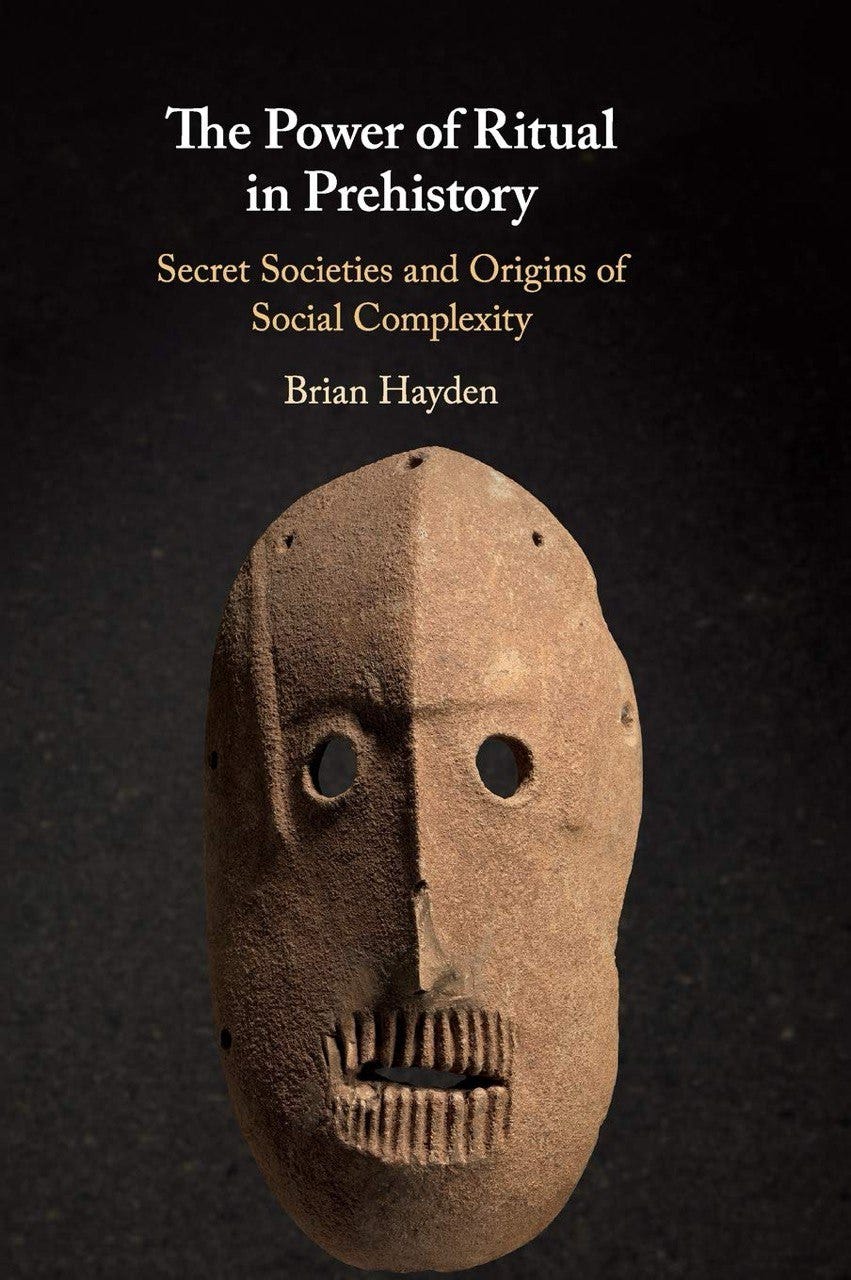
The more extreme thing you have to do to be of the “in-group”, the stronger the signal of commitment. Declaring that a person with a penis is a woman, and that the surgical and hormonal mutilation and sterilisation of minors shows “care and compassion” is a modern equivalent. You show your in-group status and commitment via horrors inflicted on the bodies of children.
Such secret societies may have led to the creation of chiefdoms. They also seem to have played a role in the shift from charismatic, apprentice-trained shamans to more systematically trained priesthoods. This leads to religions that use public rituals and distinctive doctrines to build signals of commitment on much larger scales than ritual societies can manage.
But just because states develop does not mean that kin-groups go away. The ruler’s incentive to protect taxpayers who breed more taxpayers is powerful. But there are still all sorts of circumstances where kin-groups can provide mutual self-help—including in dealing with the ruler and the ruler’s agents; or the insufficiencies of those people.
Next week: Why so many human societies have been organised around kin-groups—and the cultural and institutional consequences—is explored in Part II.
One notable exception I'm aware of is Professor of Economics and Social Policy George J. Borjas who was probably crucified for his "wrong" conclusions. "Lies, damned lies, and statistics" came to mind when he described how differing results can pop up to describe the same event. Needless to add, I trust Borjas not the other side.
Known past history has a lot to say about the mixing of unrelated ethnic groupings with far different religious beliefs, childrearing folkways and customs, particularly sexual ones. "They are people just like us, they have families just like us" is simply blind to certain ugly facts of human life.
I’ve thought this in a vague ‘I got a feeling way’ for some time. Thanks for bringing these ideas into solid form.