


This is Chinese actor Deng Kai. In the huge hit drama Zhu Yu or, in English, Pursuit of Jade—which is terrific, you absolutely should watch it—he brilliantly plays a creepy, charismatic, obsessive stalker. Naturally, he is now being mobbed by female fans. This is the intense genetic “filter” of the Neolithic Y Chromosome Bottleneck continuing to have cultural consequences.

FromWikipedia:
The Neolithic Y-chromosome bottleneck refers to a period around 5000 BC where the diversity in the male y-chromosome dropped precipitously across Africa, Europe and Asia, to a level equivalent to reproduction occurring with a ratio between men and women of 1:17. Discovered in 2015, the research suggests that the reason for the bottleneck may not be a reduction in the number of males, but a drastic decrease in the percentage of males with reproductive success in Neolithic agropastoralist cultures, compared to the previous hunter gatherers.
The development of farming and then animal herding greatly increased the number of humans—which continued to have evolutionary consequences for our species—and created productive assets (farms and animal herds) worth fighting over. Successful male teams (typically organised as clans) wiped out unsuccessful male teams and took their women as spoils.
Hence, there is a dramatic bottleneck in male lineages but not in female lineages. This pattern stopped with the development of chiefdoms and especially states, though not so much on the Steppes, whose states were more like super-chiefdoms and where intense competition over resources (and women) continued.1
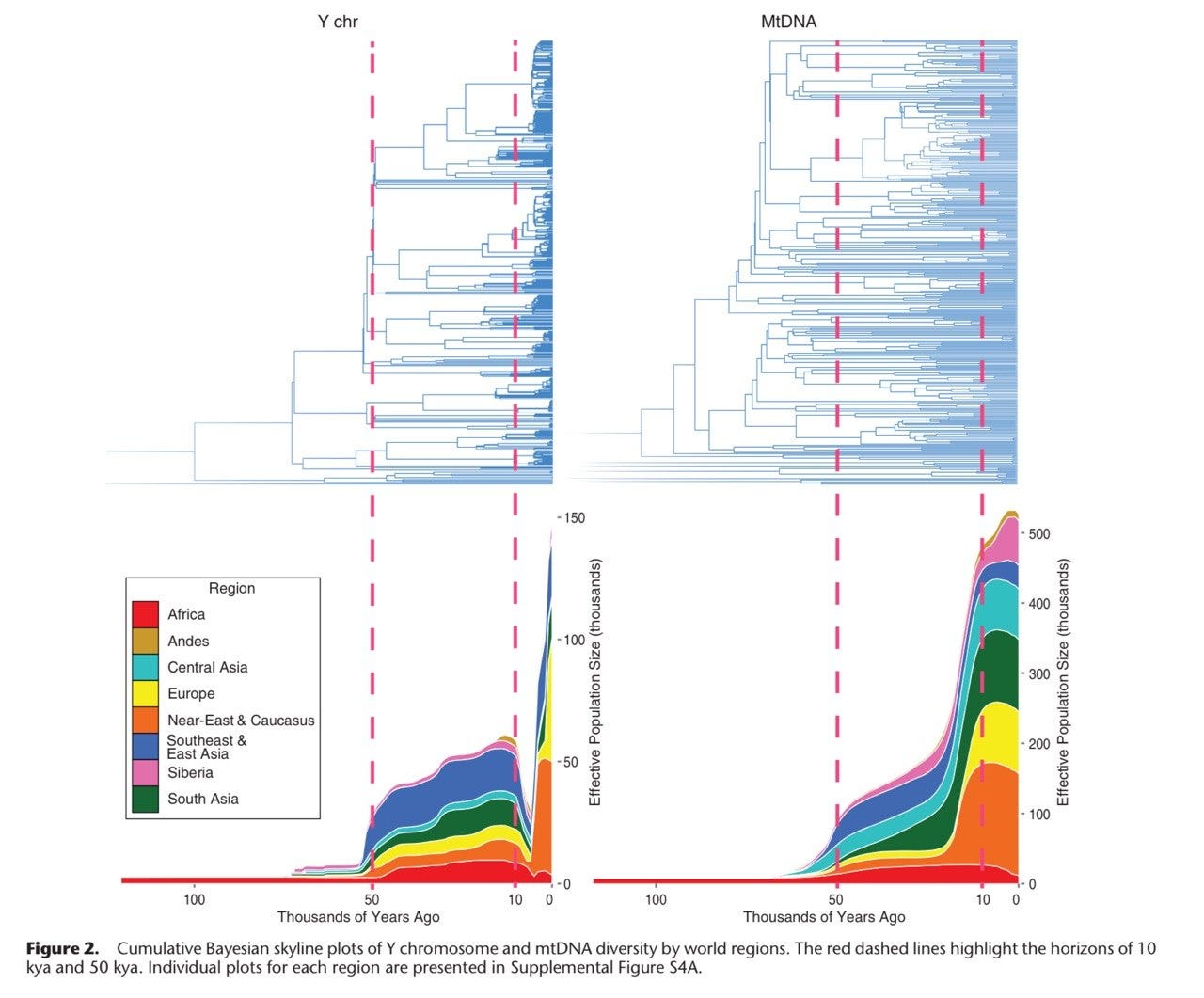
This had consequences. A major one is that the male expression of human genes became dramatically better at forming and maintaining teams—as there was drastic selection pressure for that—but the female expression of human genes did not.
This is why young schoolboy sporting teams regularly crush adult women’s national teams in team sports such as soccer. It is not that schoolboys have the strength advantage over women associated with adult men (they are often not particularly advantaged around age 14-15). It’s simply that human males are much more likely to “get” teamwork at a visceral level.
At least some of the differences in the statistical distribution of cognitive traits between men and women comes from this genetic bottleneck’s intense selection pressure differences. This is particularly clear in social patterns. For instance, men readily form hierarchies—often using physical cues such as height to do so.
Men focus on roles, suppressing or otherwise managing their emotions to do so. They regularly test each other—hence ragging each other, making appalling jokes, etc. Such mechanisms generate trust, as they test whether you will fold under pressure, whether one can say outrageous things and still get support. Hence the popular quip:
Men insult each other but they don’t mean it. Women compliment each other but they also don’t mean it.
Men roast each other as tests because so much male interaction is about teamwork, and the roles and reliability that requires, while women typically look to emotional connection. Given that the latter requires a lot of interaction to build up trust, yes, female friendships can be quite intense, but relations between human females can also be viciously unstable and fissile.
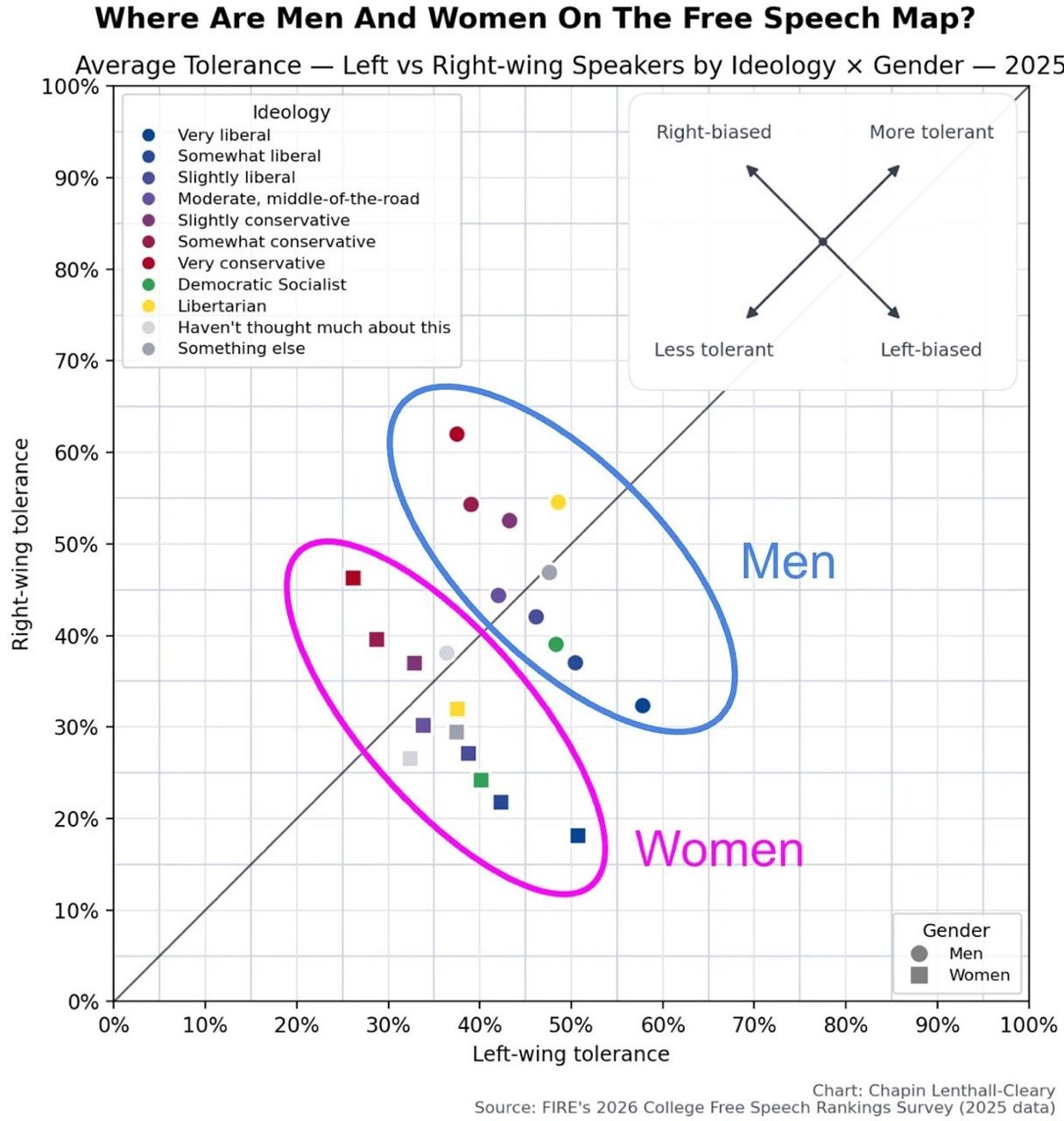
These differences have other social consequences. Men are notably more positive about free speech than women, because men often see speech as a test while women are more likely to see it as a threat. As universities have feminised, the male-female differences on free speech among students have become more pronounced. Men are systematically more tolerant of alternative points of view than are women.
Orwell’s famous comment in his novel 1984:
It was always the women, and above all the young ones, who were the most bigoted adherents of the Party, the swallowers of slogans, the amateur spies and nosers-out of unorthodoxy.
Was a great novelist doing what great novelists do: noticing.
As part of the teamwork focus, men tend to be the social solidarity sex while women are not. Women are much less likely to have friends of lower socio-economic status than are men. For women, such friends are much less likely to be worth the emotional investment. For men, they may be useful members of a future team.
As institutions, occupations and public discourse become more feminised, there has been a shift in patterns of language. A massive study of patterns of language use found a dramatic shift since the 1980s, such that:
our results suggest that over the past decades, there has been a marked shift in public interest from the collective to the individual, and from rationality toward emotion.
All this means that male-dominated institutions and spaces will be generally better, often much better, at generating and managing feedback than female-dominated spaces. When people note that feminising institutions and occupations have a strong tendency to become less functional, it is precisely because they are worse at generating and managing feedback, and at generating and maintaining trust.
Lower trust, and the narrowing of acceptable feedback, encourages safety through conformity. Modern publishing, which is very strongly female-dominated displays such problems. The decline of the global reach of Hollywood has coincided with strong antipathy to employing white males and a rise in moralised conformity in its output.
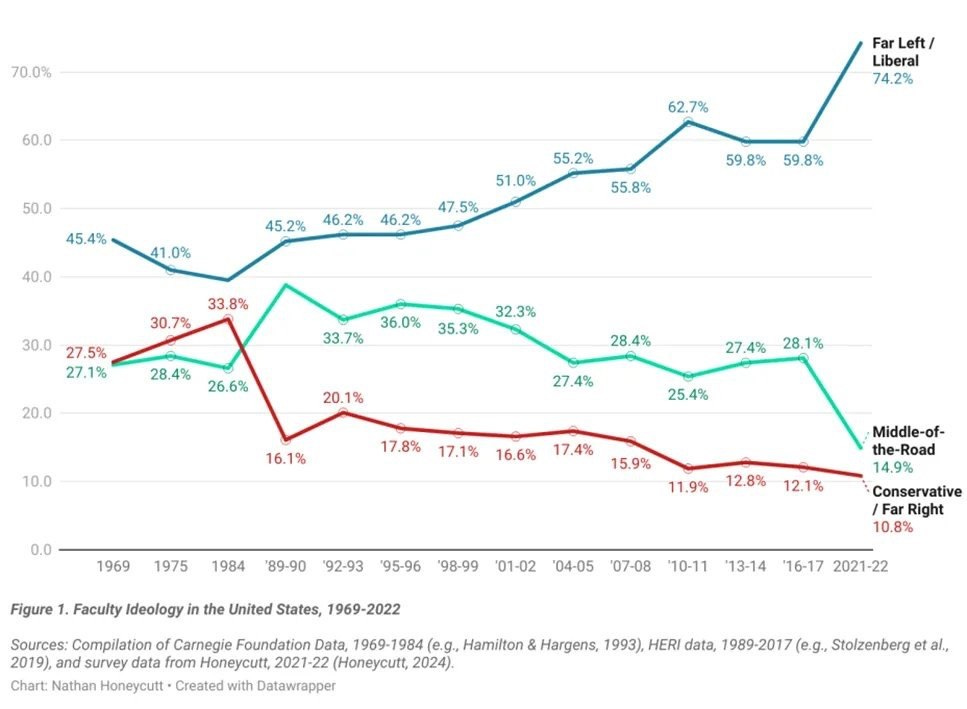
As universities have become more feminised, they have also become more conformist.
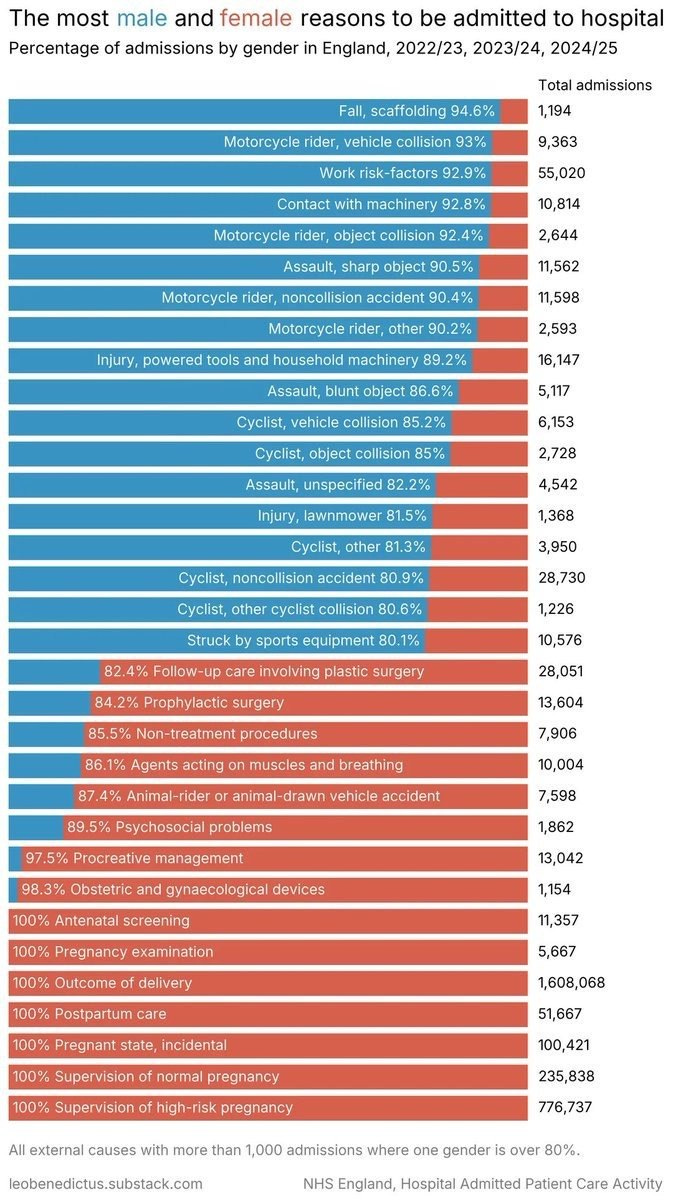
That male physical risks revolve around (inanimate) things, and female physical risks revolve around appearance and pregnancy, is explicable in terms of differing reproductive strategies, particularly in a technological species—which we have been since our Australopithecine ancestors picked up stones to bash open skulls of the left-over kills of predators to scoop out the brains and to split bones to get at the marrow. See the NHS data on hospital admissions below.
This doesn’t mean women don’t engage in extremely physically dangerous activities outside of pregnancy: note how women dominate the “animal rider or animal drawn vehicle accident” category. These are overwhelmingly horse-riding injuries. Horses are expensive (“poverty is owning a horse” as the common horsebox sticker has it) and their ownership—in England especially—tends to be confined to the upper and middle-classes. The difference is that a horse is an intelligent mammal and so can be related to emotionally; an equally dangerous motorcycle cannot.2
Hollywood’s—and academe’s and publishing’s—antipathy to employing (straight) white males also means systematically excluding the demographic (striving males) most willing to take risks. Hollywood’s leaching of originality—the endless remakes, sequels, prequels—goes with the conformist preaching that has been driving away viewers and (in the case of comics and fiction) readers. The surge in manga—and other East Asian entertainment products—is another consequence, as people switch to entertainment that takes story and character seriously, rather than the performative moralising the disfigures so much of the recent cultural output of the US and the rest of the Anglosphere.
So, not everything in male-female differences is about the Neolithic Y Chromosome Bottleneck, but some things are, precisely because it was such an intense—yet so lopsided—selection process.
While the Neolithic Y Chromosome Bottleneck did not notably affect female lineages, this obscures a different horror. Generations of women bred with a rapist who had helped kill all their male relatives. This has continuing consequences. All those romance novels and stories where a male brute is tamed by the love of a good woman hark back to this.
So does the well-known female fascination with “bad boys”. Imprisoned male serial killers generate female “fans”: criminal lawyers refer to it as hybristophilia. In more recent times, it’s become clear that some Western women are fascinated by Hamas and other jihadis, not despite them being ruthless killers, but because they are.
The notion that only men have toxic behavioural patterns is nonsense.
Which brings us back to Chinese actor Deng Kai being mobbed by (mainly female) fans after (brilliantly) playing a creepy, charismatic, obsessive stalker in a hit drama. Deng Kai is getting zealous fans not despite playing a charismatic villain, but because he has.
We like to imagine that we are free agents, unaffected by our genetic heritage. Yes, it’s true that we are the blankest slates in the biosphere, that we are the species least driven by genetically-implanted instincts. That is, however, very different from actually being blank slates.
We are the cultural species par excellence, creating ever more varied social niches. But our capacity to be cultural rests on our genetic capacities. Our genetic heritage is the substrate, the ever-present causal shadow underlying all that we do. Thus, children fare systematically better if they are raised by both biological parents than in stepfamilies, if adopted, or in single-parent families.
This genetic shadow thus includes the variation in our responses, and how much how our social patterns are driven by the statistical distribution of traits. Think, for example, how much violent crime is driven by a small, statistical “tail” of males—a tail whose size varies among human populations. How large that statistical “tail” is, and how well public policy deals with it, is fundamental to violent crime rates.
This genetic shadow extends to a Chinese actor who has been working in the industry since 2018 suddenly mobbed because of a role in a drama broadcast in March 2026 that by mid-April was already close to 3bn views.
We all know that good genes can help acting careers. But our genes, our genetic heritage, are not innocent in our reactions to actors and their performances.
We are a story-driven species precisely because our genes not only enable us to be a social, linguistic and cultural species, they help shape how we are such a species. This includes disturbing reasons for the shapes we’ve formed.
This paper attempts to explain the extreme narrowing of surviving male lineages by the adoption of patrilineal systems and polygyny. While the shift to patrilineal systems in itself does increase unequal lineage success—as does polygyny—much of the point of the shift to patrilineality was precisely that warriors who grow up together are better warrior teams.
Moreover, there is considerable evidence of violence after the shrinkage of male lineages dramatically slowed—and then reversed—with the development of chiefdoms, and especially states. These suppressed violence, but not patrilineality or polygyny. In many societies, polygyny actually intensified with the rise of states.
The bottleneck effects continued to echo down populations. The extraordinary reproductive success of particular male lineages is associated either with pastoralist violence and conquest and/or early state creation. Further, the notion that the majority of male lineages just passively accepted their reproductive exclusion flies in the face of a huge amount of evidence—especially as the examples of very successful pastoral lineages occurred in societies with notoriously high levels of violence, including as raiders, such as across the Steppes and in Ireland.
Moreover, polygyny is associated with higher rates of violence, single-spouse marriage with higher social cohesion. Nor was the creation and maintenance of states typically a peaceful process: periodic violent peaks in Chinese history, for example, were extraordinary. It was precisely the creation of a reproductively-excluded underclass that provided so much of the impetus for the banditry and mass peasant revolts that are such a feature of Chinese history. So, while patrilineality and polygyny were definitely factors in the wildly differentiated success rates of male lineages, considerable levels of violence and contestation over resources and women—that selected in favour of male teamwork—were clearly also very much in play.
Until the invention of the stirrup, women probably enjoyed an advantage over men when it came to horsemanship. It is notable that a pastoralist civilisation (the Mongols) remedied this disadvantage.
References
Ali Akbari, Annabel Perry, Alison R. Barton, et al. ‘Ancient DNA reveals pervasive directional selection across West Eurasia,’ Nature (2026). https://reich.hms.harvard.edu/sites/reich.hms.harvard.edu/files/inline-files/2026_Akbari_Nature_selection_0.pdf
Patricia Balaresque, Nicolas Poulet, Sylvain Cussat-Blanc, Patrice Gerard, Lluis Quintana-Murci, Evelyne Heyer & Mark A. Jobling, ‘Y-chromosome descent clusters and male differential reproductive success: Young lineage expansions dominate Asian pastoral nomadic populations,’ European Journal of Human Genetics, January 2015. https://www.nature.com/articles/ejhg2014285
Roy F. Baumeister, Is There Anything Good About Men?: How Cultures Flourish by Exploiting Men, Oxford University Press, 2010.
Joyce F. Benenson with Henry Markovits, Warriors and Worriers: the Survival of the Sexes, Oxford University Press, 2014.
Joyce F. Benenson, Henry Markovits, Caitlin Fitzgerald, Diana Geoffroy, Julianne Flemming, Sonya M. Kahlenberg and Richard W. Wrangham, ‘Males’ Greater Tolerance of Same-Sex Peers,’ Psychological Science, 2009, 20: 184-190. https://www.studocu.com/no/document/handelshoyskolen-bi/ledelse-og-innflytelse/benenson-et-al-2009-males-greater-tolerance-of-same-sex-peers/153562396
Judith K. Brown, ‘A Note on the Division of Labor by Sex,’ American Anthropologist, Vol.72, Issue 5, October 1970, 1073-1078. https://www.jstor.org/stable/671420
Gregory Cochran and Henry Harpending, The 10,000 year explosion : how civilization accelerated human evolution, Basic Books, [2009] 2010.
O¨rjan Falk, Ma¨rta Wallinius, Sebastian Lundstro¨m, Thomas Frisell, Henrik Anckarsa¨ter, No´ra Kerekes, ‘The 1% of the population accountable for 63% of all violent crime convictions,’ Social Psychiatry & Psychiatric Epidemiology, 2014, 49, 559–571. https://pmc.ncbi.nlm.nih.gov/articles/PMC3969807/
Jo Freeman, ‘Trashing: The Dark Side of Sisterhood,’ Ms magazine, April 1976, pp. 49-51, 92-98. https://www.jofreeman.com/joreen/trashing.htm
Léa Guyon, Jérémy Guez, Bruno Toupance, Raphaëlle Chaix, ‘Patrilineal segmentary systems provide a peaceful explanation for the post-Neolithic Y-chromosome bottleneck,’ Nature Communications, 15, 3243 (2024). https://www.nature.com/articles/s41467-024-47618-5
Heather Heying and Bret Weinstein, A Hunter-Gatherer’s Guide to the 21st Century: Evolution and the Challenges of Modern Life, Swift, 2021.
Rosemary Hopcroft, ‘Increasing Evolutionary Inequalities,’ Theory and Society, 55, 40 (2026). https://link.springer.com/article/10.1007/s11186-026-09698-8
Tim Kaiser, Marco Del Giudice, Tom Booth, ‘Global sex differences in personality: Replication with an open online dataset,’ Journal of Personality, 2020, 88, 415–429. https://onlinelibrary.wiley.com/doi/10.1111/jopy.12500
Monika Karmin, et al., ‘A recent bottleneck of Y chromosome diversity coincides with a global change in culture,’ Genome Resources, 2015 Apr;25(4):459-66. https://pmc.ncbi.nlm.nih.gov/articles/PMC4381518/
Marten Scheffer, Ingrid van de Leemput, Els Weinans, and Johan Bollen, ‘The rise and fall of rationality in language,’ PNAS, 2021, Vol. 118, No. 51, e2107848118. https://www.pnas.org/doi/10.1073/pnas.2107848118
Daniel Seligson and Anne E. C. McCants, ‘Polygamy, the Commodification of Women, and Underdevelopment,’ Social Science History (2021), 46(1):1-34. https://www.researchgate.net/publication/354584406_Polygamy_the_Commodification_of_Women_and_Underdevelopment
Jessica C. Thompson, Susana Carvalho, Curtis W. Marean, and Zeresenay Alemseged, ‘Origins of the Human Predatory Pattern: The Transition to Large-Animal Exploitation by Early Hominins,’ Current Anthropology, Volume 60, Number
1, February 2019. https://ora.ox.ac.uk/objects/uuid:da2850f1-f415-4130-9d35-8ed23fdd6b89/files/r2b88qc185
Shi Yan, Chuan-Chao Wang, Hong-Xiang Zheng, Wei Wang, Zhen-Dong Qin, Lan-Hai Wei, Yi Wang, Xue-Dong Pan, Wen-Qing Fu, Yun-Gang He, Li-Jun Xiong, Wen-Fei Jin, Shi-Lin Li, Yu An, Hui Li, Li Jin, ‘Y chromosomes of 40% Chinese descend from three Neolithic super-grandfathers,’ PLoS One, 2014 Aug 29;9(8):e105691. https://pmc.ncbi.nlm.nih.gov/articles/PMC4149484/
Tian Chen Zeng, Alan J. Aw & Marcus W. Feldman, ‘Cultural hitchhiking and competition between patrilineal kin groups explain the post-Neolithic Y-chromosome bottleneck,’ Nature Communications, 2018, 9:2077. https://www.nature.com/articles/s41467-018-04375-6

Anyone who says a motorcycle cannot be related to emotionally has never owned a motorcycle.
I would love to see an analysis on the differences in how male monasteries and female nunneries had to be managed to account for these differences in behavioural tendencies.