


Housekeeping
Helen has been busy elsewhere, kicking off Law & Liberty’s forum on the 250th anniversary of the publication of Adam Smith’s Wealth of Nations. Liberty Fund has commissioned a number of “Smith appreciations” from non-economists this month, with a view to avoiding “a bunch of economists saying the same things about WoN over and over.” You should read the piece in light of that comment.
The first post in this series discussed how the ability of societies to absorb immigrants varies due to both the society’s characteristics and immigrants’ characteristics. This includes cultural differences. Western individualism rests on the suppression of kin-groups (e.g. clans), whereas most human societies have been based, to a greater or lesser degree, around kin-groups.
If you are a new subscriber, please read that piece before starting the one below.
China: economising on administration
In China, ruling imperial dynasties operated on such a scale that using clans as intermediaries to economise on administration was an advantage, given the limits to command-and-control bureaucracy that—from the First Emperor (r.221-210 BC) onwards—Emperors relied upon. Indeed, with the development of the keju (the imperial examination) under the Sui dynasty (581-618), Emperors came to rely almost entirely on their command-and-control bureaucracy to rule. Emperors therefore developed mechanisms to limit officials from favouring their family or clan.
Nevertheless, the trade-off of using kin-groups—clans—to economise on administrative costs by supporting their ability to provide risk-management and other services to their members and using them as intermediaries was worth it for Emperors of China, so they kept making the trade-off. Indeed, as the population of China trended upwards—so the incentive to economise on administration increased, given that there was a practical limit to how many layers of bureaucracy Emperors could control—Emperors tended to strengthen the role of clans. The more divided geography and linguistic demography of Southern China—which increased administrative costs—particularly encouraged use of clan structures to economise on those administrative costs
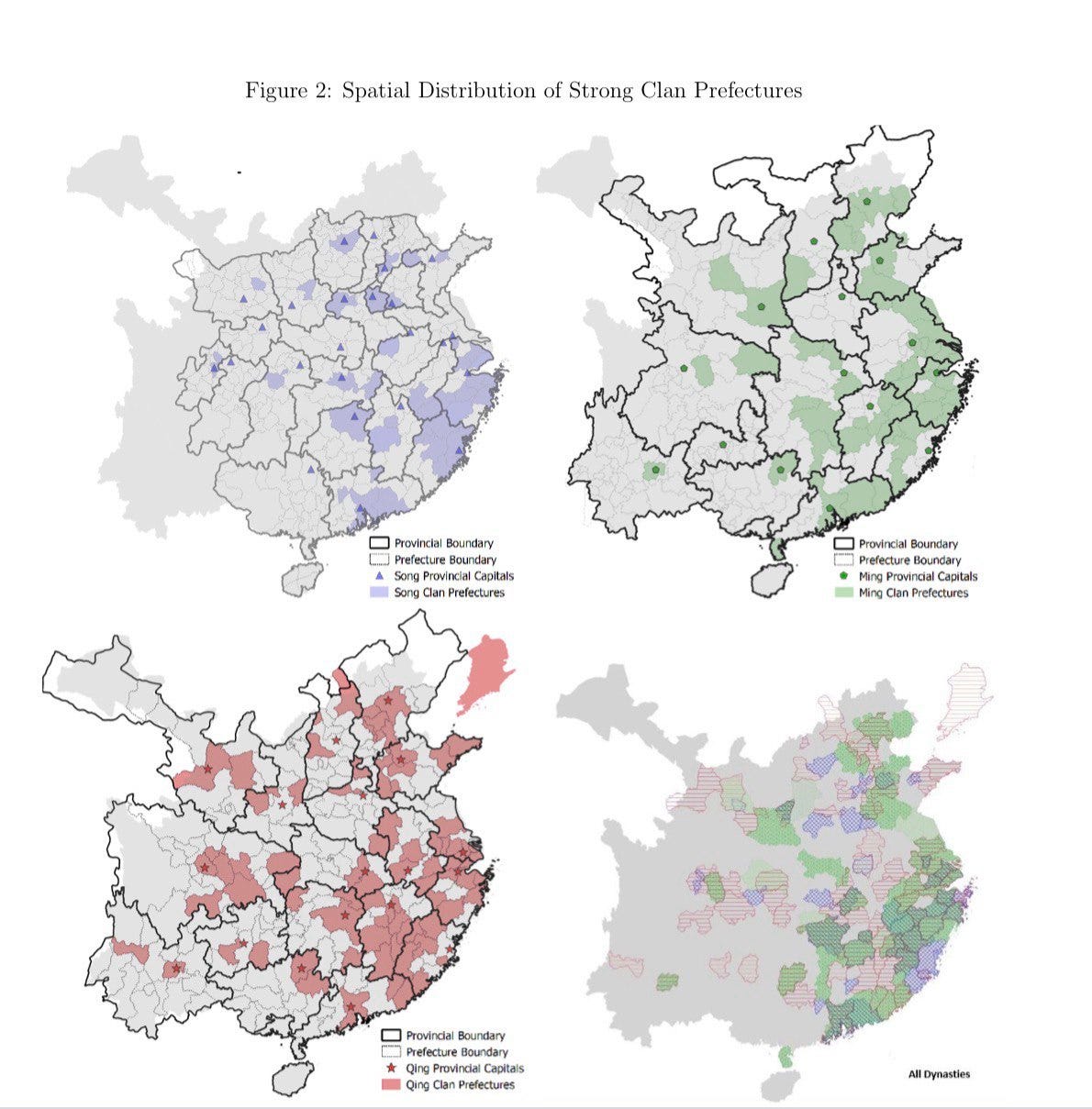
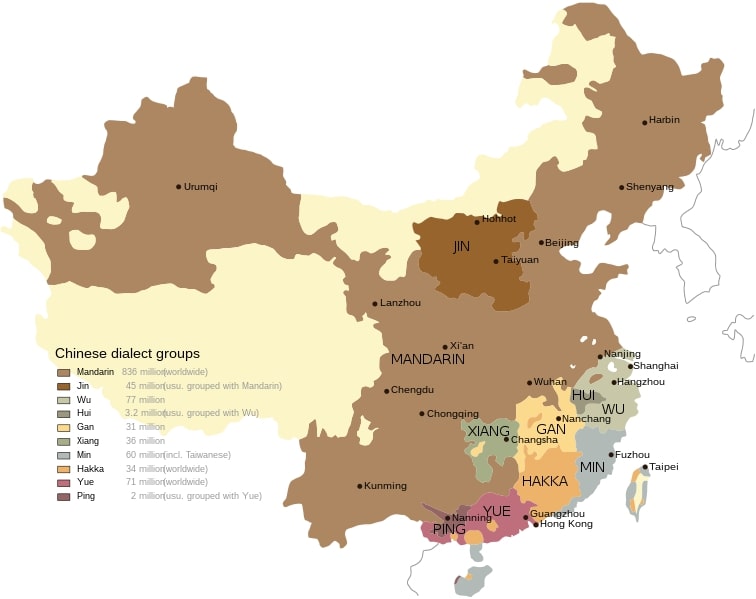
This pattern made sense for Chinese emperors, due to the remarkable scale unified Chinese states operated at and the level of reliance of Chinese Emperors on bureaucratic command-and-control mechanisms to rule. Even so, the temptation to use eunuchs—who had daily access to the Emperor and whose kin loyalties were atrophied by their not being able to have children—was also a perennial feature of Imperial Chinese history.
Arabising the Middle East
Far more people in the Middle East claim to be Arab than are genuinely of Arabian peninsula ancestry. Not only were the conquering Arab tribes fairly small in number, they rapidly became a largely urban elite. It is usual for conquering pastoralists to be hugely outnumbered by the farmers they conquer.
The conquering Arabs were an elite organised into kin-groups (i.e. Arab tribes). When Arab tribes were abandoned as the basis of military forces in the Abbasid Revolution (747-750), there followed a shift to use of slave warriors due to the perennial problem of kin-groups—rulers came and went, the kin-group was forever. To avoid having kin-groups colonise their military forces, rulers switched to slaves—either imported from afar or, in the case of the Janissaries, local non-Muslims. A slave’s only legally-recognised connection was to their master.
Out in the countryside, the largely Christian peasant farmers continued as before, on plots of land that were generally freehold. Locality-based congregations, dioceses (bishoprics) and villages functioned fine as organising mechanisms.
They so functioned until Islamic polities “feudalised”—that is, Islamic rulers switched to using far more fief-paid, rather than salaried, cavalry: notably under the Iranian Buyid (934-1062) and the Turkish Seljuk (1037-1308) dynasties. As property was subject to Sharia inheritance laws, warriors could not be allocated land-fiefs, since Sharia required distribution of property amongst all a man’s children. That would have rapidly dropped land-holdings below being large enough to support a mounted, armoured warrior, which was the point of such fiefs. Instead, warriors were allocated tax-collection rights which remained—at least in form—a manifestation of public authority, not private property.
This had an effect on peasant landholding, as farms were changed into, effectively, leasehold controlled by the local fief-holders. (Orchards remained freehold, as they were long-term investments.) This made the situation of local farmers much more insecure, which meant they searched for better risk-management mechanisms. The increased insecurity of property also made the jizya, the tax on non-Muslims, more onerous.
The result was a shift to adopting Islam—to avoid the jiyza tax and increase one’s social and legal status—and an Arab identity, to increase status and justify arranging communities into self-help kin-groups based on alleged common (Arab) ancestors. The states of the city-based Arab and Islamic elites had limited control of the countryside. The decentralisation of military forces to tax-fiefs weakened central control further. The adoption of Arab identity and “Arab” kin-groups by farmers gave them self-protection, risk-management and cooperation mechanisms. Hence, from the C10th onwards, the farmers “became” Arab and were organised in kin-groups.
There is an excellent discussion of all this with historian Yossef Rapoport, based on his book Becoming Arab: The Formation of Arab Identity in the Medieval Middle East. This adoption of Arab identity, and of kin-identifications, is a case study of how neither ethnicity nor kin-groups are primordial, but historical entities that come and go. It also illustrates the wide range of interactions between states and kin-groups.
As Prof. Rapoport notes, Old Kingdom Egypt (c.2700-2200BC) was the first nation-state—the notion that the nation-state was a European invention, or that politicised national identity was a C18th invention, is flatly not true. Pharaonic inscriptions have plenty of condemnations of damn foreigners while Aethelstan proclaimed himself King of the English (Rex Anglorum) in 927—his various successors did not swap to primarily calling themselves King of England (Rex Angliae) until John (r.1199-1216). From the reign of Gustav I (r.1523-1560) until the succession of the present King in 1973, the royal title of Sweden was rex Svecorum Gothorum Vandalorumque (“king of the Swedes, Geats and Wends”).
Islam is, in many ways, structured to foster kin-groups. You do not have to be Arab for Islam to have this effect. Both Amazigh (Berber) culture and Somali culture operate very strongly on the kin-group model. A culture which is oriented very strongly around both collective religious and clan identity is culturally very far from the individualism upon which Western institutions are based.
Whether it is foreign aid in Somalia itself, or the Swedish or Minnesotan welfare states, the pattern of you tell the kaffir outsiders handing out the money whatever they need to hear, and then distribute the goodies across your clan and patronage networks, is very strongly followed. That is how their culture works. That is how they culturally map cognitive significance. It is a manifestation of how the level of state corruption correlates so remarkably (0.91) with how collectivist cultures are.
The larger the number of Somalis imported, the more their cultural patterns are going to be maintained and reinforced. Add in Swedish and Minnesotan politicians seeking to mobilise votes, activists and donations; top it up with deference to “people of colour” and “decolonisation by immigration”; and the systematic debauching of local institutions must be expected. Hence Sweden has been reduced to paying them to go away. The US should deport the lot, pour encourager les autres. It is not as if the USA (or Sweden) could not replace them with better immigrants.
When locality wins
The imperial Chinese state’s use of clans to economise on administrative costs has little or nothing to do with the dominant forms of farming in China. Rice farming does not, in itself, encourage kin-groups. On the contrary, there is shared interest in managing irrigation by locality. This point also applied to irrigated farming generally—e.g. wheat and millet farming along the Yellow River.
Across history, locality is the dominant competing cooperative mechanism to lineage (i.e., the kin-group). Classical Athens (with Solon’s reforms); the Roman Republic; congregational Christianity—all used or use locality as a replacement connection-and-cooperation alternative to lineage.
The elevation of neighbourhood connections seems to be undermining kin-groups in contemporary Middle Eastern cities. Nowadays, Christian (especially Pentecostal) congregationalism is regularly used by Sub-Saharan Africans—especially African women—as a refuge from the demands of kin-groups and a replacement source of opportunity-seeking and risk-management connections.
The medieval Papacy took about a century-and-a-half to establish a parish church system in clan-dominated Ireland precisely because parishes elevated locality over lineage and the Irish Church itself was dominated by clan networks. It was the normal problem of kin-groups—Popes came and went, the clan was forever. If the medieval Papacy had any doubts about the importance of suppressing kin-groups, its endless trouble in asserting control over the Irish Church was a perennial reminder.
Indian jati that are based on occupations operate as an alternative social cooperation and risk-management mechanism to kin-groups. Such jati have the further advantage that marrying inside the occupation group means that both parents understand what is required to train sons to work in that occupation and for wives to bring up the next generation of that occupation. Given the enormous memorisation burden a brahmin boy originally had to learn, occupation-based jati seemed to have developed as a cascading social pattern from brahmin marriage strategies for inter-generational skills transmission.
Religions and sects
Religious identities can also operate as an alternative to lineage as an organising mechanism. The Sufi tariqa (orders/sects) of Islam regularly operate this way, though they often have a family that provides hereditary leadership. The Tong, Triads and various sects of China provided non-lineage connections through belief-and-ritual. Their role waxed and waned depending on the Chinese dynastic cycle.
The Chinese dynastic cycle was driven by:
• Population increase from dynastic pacification coming up against resource limits, limiting the number of farmer niches and tending to shrink them as population pressure increased. Such shrinkage made taxes progressively more onerous. Population increasing beyond the number of viable farming niches created an ever larger bandit/underclass.
• Elite polygyny expanding elite aspirants faster than elite positions.
• Pathologies of bureaucracy increasing over time.
Disappointed elite aspirants organising peasant revolts is a recurring theme in Chinese history. The bloodiest civil war in history, the Taiping Rebellion (1854-1860), was an example of this. As the CCP itself was a form of such organising, it is very exercised about some new version developing.
As so many of the great peasant revolts that are such a feature of Chinese history were organised via sects—including the Yellow Turban Rebellion (184-205); the Red Turban Rebellion (1351-1368) that overthrew the Yuan dynasty; the White Lotus Rebellion (1794-1804); the Taiping Rebellion, via the God Worshipping Society; and the Red Turban Rebellion of 1854-6—Chinese central governments have a long history of being suspicious of sects. A history of suspicion that the CCP continues—see Falun Gong.
Divided loyalties
Imperial China was an unusual case. Generally, rulers found kin-groups frustrating: precisely because rulers came and went, but kin-groups are forever. Kin-groups would colonise every organisation, including the rulers’ own instruments of rule.
The Greek city-states (such as Athens) and the Roman Republic used locality to suppress lineage because of the urgency—when one relied on citizen soldiers—of creating a shared commitment to the polis, the city-state. Riffing off mechanisms the Romans had developed, manorial Christian Europe forged an elite alliance to suppress kin-groups.
In Medieval Europe, everyone who owned manors—which was almost everyone who mattered from knights to kings—had an interest in suppressing kin-groups as kin-groups competed with the manor-holders’ authority over their manors. Moreover, Popes did not want kin-groups colonising the Church. Kings did not want kin-groups colonising their instruments of rule.
So, the Latin Church’s suppression of kin-groups was endorsed and supported by the elite within Christian societies. This was essentially an intensified development of Roman mechanisms to suppress kin-groups: single-spouse marriage; no cousin marriage via very encompassing incest taboos; consent for marriage; and testamentary freedom.
If kin-groups can control neither marriage nor the transfer of wealth, and are not used to organise either—while locality-based connections work—kin-groups atrophy very quickly. All these measures could be entrenched via law that was not based on revelation.
Christian Europe thus had three advantages in suppressing kin-groups. First, there was the Roman example itself.
Second, “Render unto Caesar” separated law from revelation. Law was explicitly an exercise of human authority and could be—and was—mobilised against kin-groups. Even better, social bargains could be entrenched in law, making formal bargaining processes worth the effort.
The control of most law within Islam by religious scholars, the ulama—based on revelation—prevented use of the mechanisms available to Christian rulers and elites to suppress kin-groups. Grounding law in revelation also massively reduced social-bargaining possibilities. Brahmins making similar claims via Manusmriti and similar texts had similar effects. The difference nowadays is that not even the maddest Hindutvas want to revive Brahmin law.
Third, there was a series of locality-based mechanisms—manor, congregation (parish), self-governing cities—that could be utilised to replace kin-groups. There were also occupation-based guilds, while a range of social cooperation mechanisms were developed, including corporations and feasting (often based on the veneration of a particular saint).
Fourth, Germanic taboos against close relative marriage and insistence on the primacy of oaths of service over kin-group connection provided a culturally-resonant lever. The epitome of the latter was the warrior band or comitatus, forms of which seem to be a perennial across steppe cultures.
As part of its evolution of institutions remarkably convergent with those in medieval Europe, Japan was also a culture where sworn loyalty could trump kin-group. Japan is a case of a similar evolution of institutions to medieval Christendom without the specific Roman example or later Christian development of it.
Despite the Arthurian stories being originally based on Celtic sources, the personally-sworn loyalty of the Knights of the Roundtable is Germanic. The Arthurian tales provide in epic form a cautionary tale where Arthur’s “Germanic” individual sworn-loyalty Roundtable is brought down by fractious Celtic kin-group loyalties.
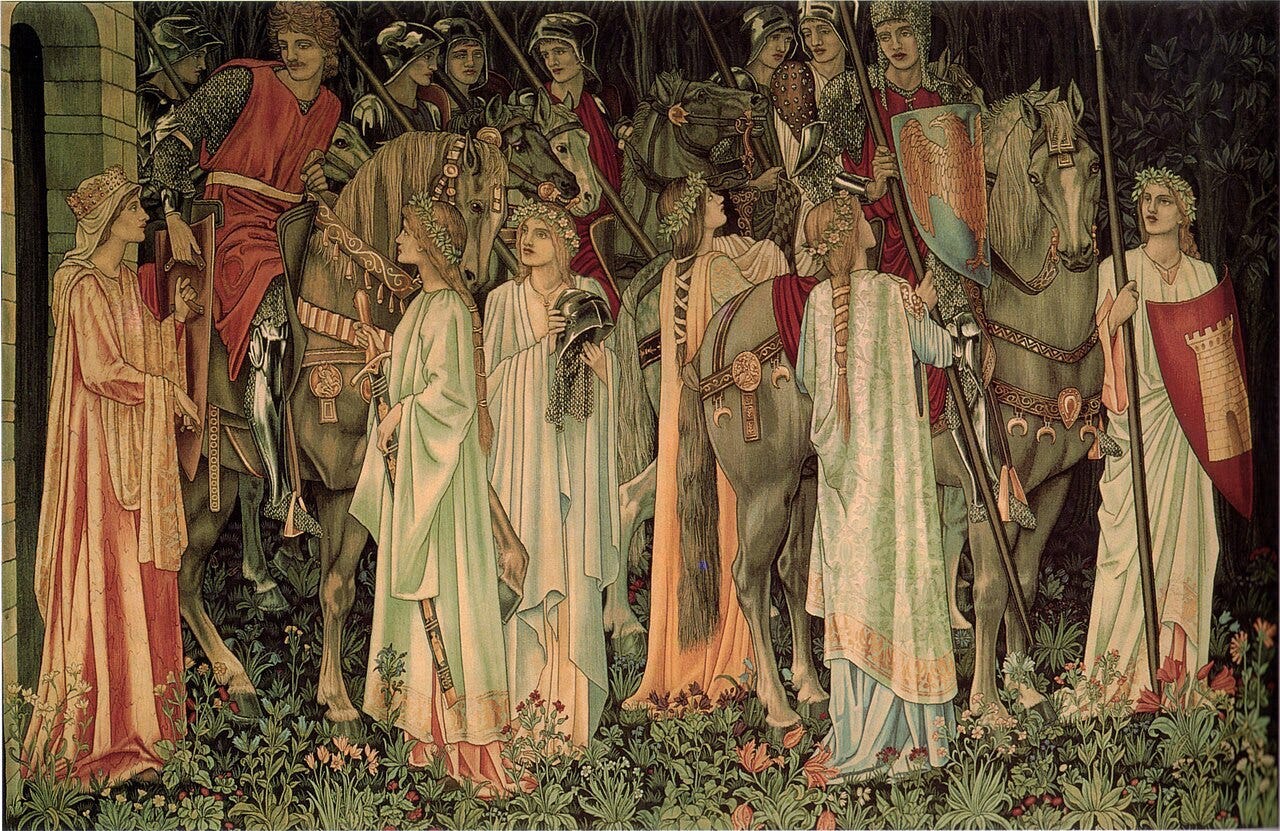
Germanic cultures had a more fluid openness to cooperative opportunities that advantaged them over Celtic cultures more restrictively based on clans. As a friend says, it is a principle of Welsh history that there is always a stupid younger brother.
A problem for monotheism when it comes to kin-groups is that monotheism creates a unified moral order—that is its key social-selection advantage. It is why monotheism is selected for on the ecological borders between pastoral grasslands and farmlands—people could connect and move across the ecological boundary within the same moral and ritual order. As the Middle East is where farmlands and grasslands are most intertwined—so that social-selection advantage of monotheism is strongest—all major monotheisms come from the Middle East.
Islam arose in an Arabian peninsula where pastoralism and farming were very ecologically intertwined. Because Islam is based on the sanctification of a pastoralist social synthesis, this includes sanctifying the sexual exploitation of outsider women: a pattern seen in ISIS’s theology of rape. This social script has also manifested in the British grooming gangs, the Dutch “lover-boy” gangs and (the prosecuted and gaoled) Muslim Lebanese rape gangs in Sydney.
Mass rape and sexual exploitation has proved to be a cost of Muslim immigration, though the cost is much reduced if the local civic culture is strong enough to suppress it.
The unified moral order of monotheism breaks down the ritual boundaries between kin-groups that reverence for ancestors generated. This ritual boundary is used in non-monotheist cultures to prevent marriage within kin-groups. The adoption of monotheism—by eliminating this ritual boundary—thus enabled marriage within the kin-group.
There are a lot of advantages to marrying within the kin-group. It keeps assets within the kin-group. It means the women are breeding warriors for their own kin-group, not someone else’s. In patrilineal systems, marrying within the kin-group is safer for women, as they stay within their existing kin-connections rather than being isolated inside a different kin-group.
The trouble is, marrying inside the kin-group for generation after generation is genetically bad, generating increasingly high rates of birth defects and general sickliness. The evolved mechanism of ritual-boundaries mandating out-marriage has been positive for the genetic health of kin-group lineages.
Moreover, marrying within the kin-group intensifies the importance of kin connections and narrows cooperative opportunities—something that St Augustine (354-430) (correctly) criticised cousin marriage for. Research suggests that the rule of the clan does not increase confidence in fellow clan members as much as it reduces trust for non-clan members. The net effect is to create lower-trust societies which in turn encourage more use of the dense connections of lineage for risk-management and social cooperation.
This lowering of trust in outsiders—and elevation of kin-based connections and patronage systems—is why there is such a startlingly high correlation (0.91) between how collectivist the local culture is and how corrupt the state is.
Conversely, the suppression of kin-groups in Christian Europe created highly individualist cultures that were much more fluid in their ability to engage in, and create, cooperative opportunities, tending to become higher trust societies over time. Hence, the crucial mistake that liberal universalism makes is in not recognising how much the individualism it takes for granted is a creation of a particular cultural matrix.
Institutions are cultural creations
Institutions are built around norms and rules. These may well be self-reinforcing, but they are also subject to erosion. The stronger the “capstone” civic culture of a polity is, the more those institutional norms and rules are likely to be enforced. The original civic nationalists—the Romans—were entirely correct to insist on Roman citizens, especially new citizens, adhering to the civic culture that underpinned Roman institutions.
Institutions may well have economic functions—even economic purposes—but they are cultural creations first and foremost precisely because they are based on norms. Formally similar institutions regularly operate differently in different cultures.
The more culturally distant immigrants are, the more adjustment is required by them to the norms and rules that make the institutions of the country they are entering function effectively. The less such adjustments are required of the newcomers, the more corrosive will be the impact of such immigrant cultural differences on those norms and rules, and so those institutions.
We can see Somali immigration corroding local institutions in Minnesota. We can see Muslim immigration corroding local institutions in the UK. Yes, they are being aided and abetted by local politicians and activist networks, but that is precisely the point—the civic culture of Minnesota, and of the UK, is not strong enough to stop them.
The weaker that the civic culture is, the less the successful immigrant absorption capacity of the local polity will be. This means, of course, that the more local activists and politicians undermine civic culture—and its institutional norms and rules—the lower the successful immigrant absorption capacity of that polity is.
It is a lot easier to destroy general social trust than it is to build it. Destruction of such trust—seen in such things as the mockingly named “diversity bollards”—is another cost of culturally incompatible mass immigration. Both historical experience and computer simulation suggest that reversion to lineage-based dynamics is likely if such generalised trust breaks down.
Of course, if one wants—as clearly many left-progressives do, as they say so—mass immigration to be a lever to corrode Western civic cultures; to corrode Western institutional norms and rules; then that is all fine. It is also stupidly toxic and a profound treason against one’s society. It becomes yet another example of left-progressives being the enemies of human flourishing; just as they have proved to be again, again, again, and again. Left-progressivism never, ever, achieves what it says on the tin, and is always hostile to human flourishing, due to left-progressives pathological relationship with information and the falsity of the foundational beliefs necessary for their politics.
Precisely because we humans cognitively map significance, not facts; precisely because our cultural capacities are the secret of our success as a species; immigration is far more of a cultural issue than an economic one. It is the failure to grasp this which has, again and again, led conventional centre-right politicians to screw up the cultural politics that mass immigration generates.
The capacity for culturally incompatible groups to erode institutional norms, the dynamics of globalisation, divisions within Western societies—and their implications for the ability to absorb immigrants—are further explored in Part III (forthcoming).
This is such interesting, well-researched stuff. Thank you for working on it so tirelessly, and collaborating to get it out to a bigger audience. I lack the deep historical knowledge to provide a genuine critique of what is being presented here, but a lot of it tracks for me from life experience
Thank you, many new facts for me, specifically about Arab identification.
One point about this passage: "Of course, if one wants—as clearly many left-progressives do, as they say so—mass immigration to be a lever to corrode Western civic cultures; to corrode Western institutional norms and rules; then that is all fine. It is also stupidly toxic and a profound treason against one’s society. It becomes yet another example of left-progressives being the enemies of human flourishing." Yes, it is all true, and what left progressives do not see is that they replace themselves with the unified immigrant kin groups. Thus, such kin groups not only colonize say Minneapolis, they displace the left politicians, because they artfully take on the woke progressive verbiage ( you tell the kaffir outsiders handing out the money whatever they need to hear, and then distribute the goodies across your clan and patronage networks) - while destroying the societal trust.
See who runs London or New York, and also, the new anti-Islamophobia administrator in UK, who is a muslim herself - yes, the fox inserted herself to guard the chicken coop ready for plucking.
https://www.independent.co.uk/news/uk/politics/islamophobia-government-social-cohesion-antisemitism-b2933758.html - and this is a "part of its social cohesion strategy" - meaning completely browbeating the aboriginal Brits into compliance. Somehow no aboriginal rights here.