

Given the sheer amount of news happening globally right now, I hope I can be forgiven for writing about something that is, by comparison, trivial—an Australian writers’ festival blowing itself up.
I’m writing this because the exploding literary festival in question is illustrative of, well, quite a number of things—some to do with the Bondi Massacre. Others concern the parlous state of the creative arts throughout the developed world.
The short version: Palestinian-Australian writer Randa Abdel-Fattah has been on the receiving end of some pretty serious deplatforming, the effect of which has been to blow up not one but two Australian literary festivals.
First, in August last year, was the Bendigo Writers’ Festival. Australia’s Jewish lobby persuaded the festival to adopt a code of conduct requiring invitees to avoid discussing “language or topics that could be considered inflammatory, divisive, or disrespectful” and mandated compliance with a major university sponsor’s anti-racism policy. Writers had only two days to comply, and as a sometime attendee of writers’ festivals in the past, I can assure you their speeches would have been written and readings selected.
Led by Abdel-Fattah, this mix of inconvenience and censorship meant most writers bailed out, and the festival collapsed.
Bendigo is a prosperous regional city (pop. approx. 100K) in country Victoria, and its city council was not really in a position to save it—everything happened at such short notice.
This week, the Abdel-Fattah cancellation roadshow made its way to Adelaide Writers’ Week, which is part of the larger Adelaide Arts Festival. For British readers, the relationship between the two bodies is akin to that between the Edinburgh International Festival and the Fringe or Book Festival. It has a decent claim to being Australia’s flagship literary festival, although Sydney and Melbourne do try to contest this.
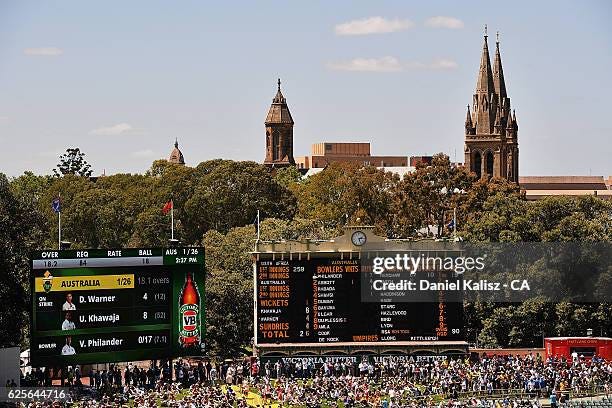
Adelaide is the state capital of South Australia, has a population of approximately one and a half million, and is famously rich, beautiful, and cultured. Cricket fans are invited to recall the gorgeous Adelaide Oval. For everyone else, the whole city is like that.

South Australia was Australia’s only “free colony”—no convicts were transported there—and this has produced some oddities. South Australians have a different accent from other Australians, and the broad culture of its intellectuals—going back long before Federation in 1901—has had an extraordinary impact on Australian constitutionalism and politics. Catherine Helen Spence, one of Australia’s Framers (and designer of the country’s remarkable electoral system), came from Adelaide.
In a story with some similarities to the Bendigo Writers’ Festival stooshie, Randa Abdel-Fattah was deplatformed from Adelaide Writers’ Week over what can be described as a pretty feral social media feed. At first blush, Adelaide’s effort appeared to be heading in the same direction as Bendigo’s—down the long slide. Writers have been bailing out left and right, and the festival website listing attendees has been deleted because so many authors are no longer coming.
However, in between the two festivals, the Bondi Massacre happened, and the country has changed. I wrote about that process for Law & Liberty.
Before Bondi, it’s fair to say that the Pro-Palestinian position had broadly “won” the public argument in Australia. Unlike in the UK, this was not achieved by intimidation or controlling the streets. Outside the universities, pro-Palestine protests were generally orderly and calm. Relatedly, Australia’s Palestine lobby had not become associated with cancellation campaigns—unlike the Jewish lobby.
This framing reached its nadir for Australian Jews when—in June 2025—the Federal Court ruled against them in Lattouf v Australian Broadcasting Corporation. That case concerned a campaign to get Antoinette Lattouf, a pro-Palestinian journalist, sacked. She litigated using Australia’s robust industrial relations legislation (the Fair Work Act), and she won. Employers that give into cancellation campaigns—and people who engage in them—were put on notice.
Attempting to get people sacked for their views is despised in Australia, something with deep historical roots in the country’s still powerful trade union movement. Among other things, the Lattouf ruling led the country’s trade unions to adopt a uniform pro-Palestine position. The current Federal government is Labor, and depends heavily on the trade unions for both political and financial support. Australia recognised a Palestinian state in short order.
Then Bondi happened.
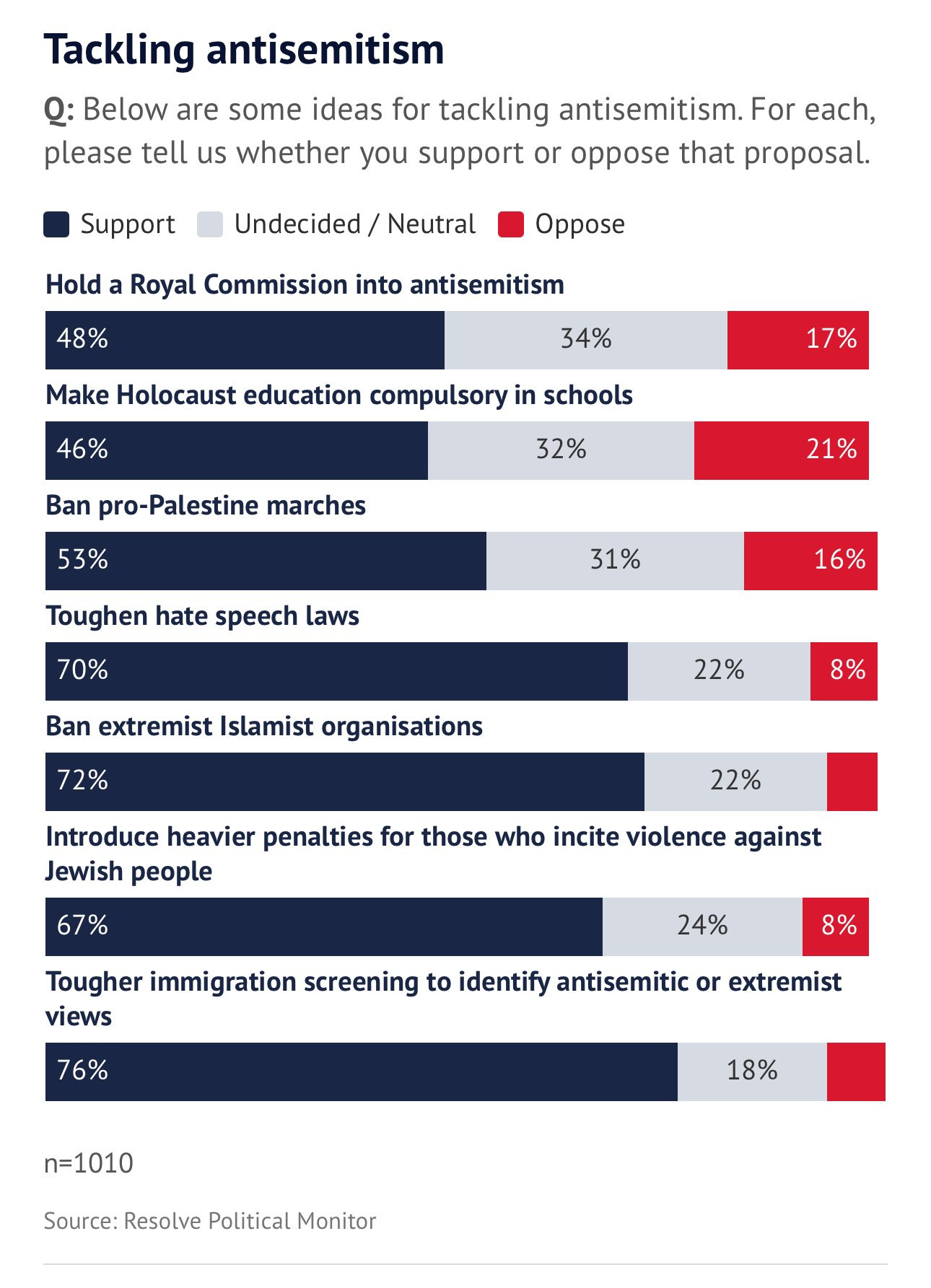
The Australian electorate’s Eye of Sauron1 turned on both Islamism and Palestinian activism the way it had previously focussed on Jewish activism. The poll below—undertaken shortly after the massacre—indicates the consequences. Positions have only hardened since then. Until Bondi, Australia’s cheerful, smiley PM, Anthony Albanese, had been genuinely popular. Now—while people still like the Australian Labor Party—Albanese’s personal approval ratings are in the toilet.
This—as much as anything—is why Albo (as Australians call him) has ordered one of Australia’s famously toothy Royal Commissions both into the Bondi Massacre and wider anti-Semitism.
So while Australia’s (generally pretty far left; I’m the country’s only literary Tory of renown) writers and artists may view Adelaide Writers’ Week events through the same lens they used last August—when Bendigo blew up—the wider Australian electorate no longer agrees with them.
Peter Malinauskas, the South Australian Premier (equivalent of a US governor or—roughly—Scotland’s First Minister), has therefore come out playing hardball, both against Abdel-Fattah and Australian literary culture more widely.
I pause here to note that Malinauskas is also Labor, but comes from a different ALP faction and a different trade union background than Albanese. A long-standing member of the Shop, Distributive and Allied Employees’ Association2 (known as “the Shoppies”)—one of Australia’s right-leaning unions—Malinauskas has (probably) made use of his union’s “dirt unit” to grub up some seriously damaging information about Abdel-Fattah, viz:
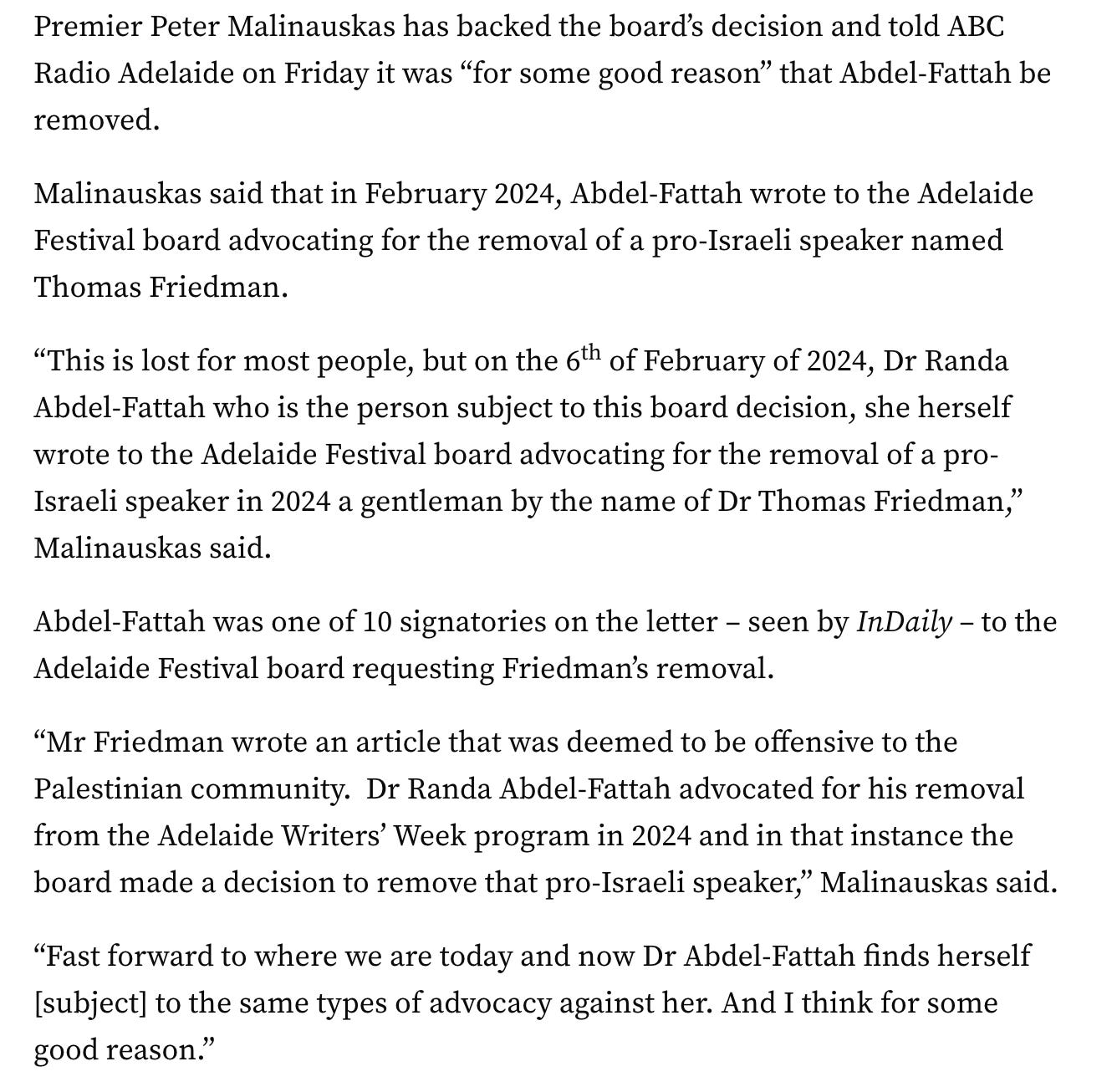
Abdel-Fattah has been complaining long and loud about cancellations for the best part of six months—and getting a lot of public sympathy as a result. However, this depended on her own involvement in a cancellation campaign not coming to light.
Interestingly, Thomas Friedman did not kick up a stink when he was deplatformed in 2024. I’m not sure why this is, but—if Wikipedia is to be believed, always a big if—he appears to be a fairly conventional Jewish lobby figure, and so supports hate speech laws and no-platforming. He may have felt constrained from objecting on “sauce for the goose, sauce for the gander” grounds. Although not widely known in Australia, he is nonetheless a genuinely distinguished writer, and has won three Pulitzer Prizes.
Two things fall out of this. First, Abdel-Fattah has been exposed as a hypocrite, while her behaviour shows the extraordinary temptations of relational aggression as an activity. Secondly, she has engaged in a behaviour—female-coded relational aggression—that Arab men hate with the blazing heat of a thousand suns.
If it’s possible to despise rumour-mongering and sneaking behind other people’s backs more than Australian unionists do, then those haters will be Arabs. A (small) insight I picked up living and working in the Middle East (chiefly Syria, but I also travelled to other countries) is that one reason—among many—Jews and Arabs don’t get on is because the two peoples often define bravery differently.
A (final) literary note
When my publisher tried to organise a launch slot for my second novel (2017) and third novel (2018) at Adelaide Writers’ Week (in separate years obviously), it was stymied at every turn. This is despite its managing editor being from Adelaide literary royalty—a distinguished writer in his own right, and the son of an even more distinguished South Australian writer—and me being a Miles Franklin Award winner.3 Like the late Clive James—who also struggled to get Australian literary festival invitations—I’m non-U in Australia’s literary community. With me, it’s because of my right-wing politics. James, for his part, was a climate change sceptic despite being broadly centre-left in other respects.
Australian literary and artistic culture is, ahem, not healthy, not diverse, not of high quality, and horrendously parochial—all at once. As in Britain and the US, publishing is a censorious mess dependent on government largesse for both writers and festivals. As you’ll see from the links in this piece, the South Australian state government is in the hole to the tune of AUD $10 million (GBP £5 million; USD $6.7 million) for this year’s festival. Okay, Australia is a filthy rich country compared to the UK and US, but Malinauskas is still within his rights to be pretty pissed off with the sheltered workshop for woke hacks his state’s writers’ week has become. “Peter Malinauskas shat in our trousers” really doesn’t sound in damages, lit-gits of Australia.
The only libertarian political position I hold in unadulterated form is that there should be no state support for the arts. Make me Arts Minister and my sole ambition would be to make my place in Cabinet redundant. Since Wokery’s emergence, this has become even more urgent. The creative arts need to spend a good thirty years being forced to cater to the market/lowest common denominator to flush out the crap.
We need more starving artists forced to work normal day-jobs while being stigmatised as losers and weirdos by plumbers and shop assistants—they may even learn something. I recognise this probably means a few years of Survivor: Hay Festival (how will contestants survive the Sea of Smug that place radiates?) or Sydney Writers’ Week Luvvie Island. After that, a genuinely new avant-garde may emerge, but the cleanup has to happen first.
Addendum (added one-pm-ish GMT on Sunday 11th January)
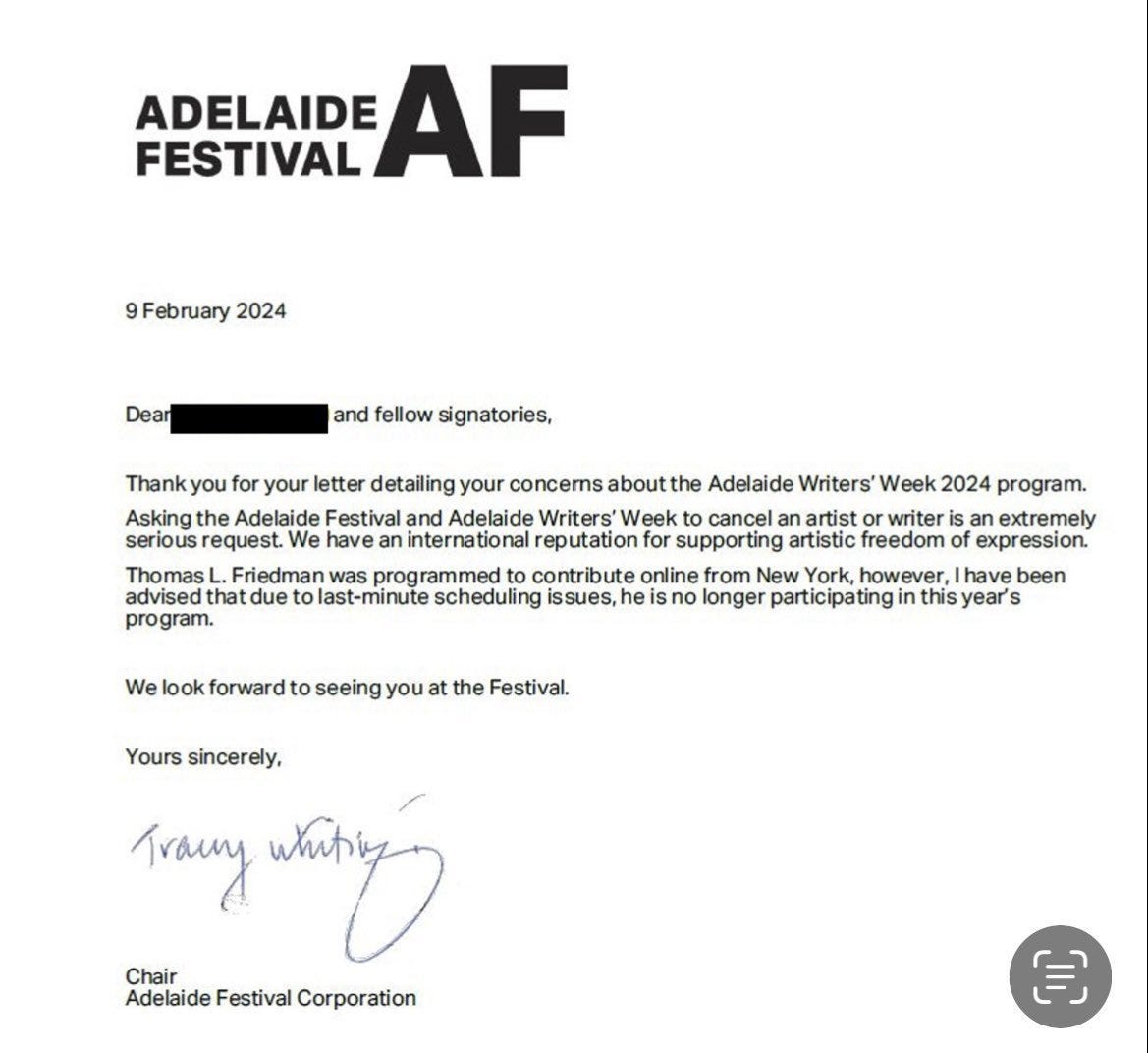
There is evidence circulating that the reason Thomas Friedman did not kick up a stink in response to an attempt at cancellation is because he ran into a scheduling issue:
I will, here, insert a few caveats.
Everyone is assuming that the redacted name is Randa Abdel-Fattah. It may not be. It may be one of the other nine people involved in the original incident Malinauskas described.
Everyone is assuming it is genuine. I think it is genuine (I have seen it shared by people close to the Festival and of unimpeachable integrity), but we can all be fooled, and the easiest person to fool is yourself.
Everyone is assuming that Abdel-Fattah’s cancellation campaign was the only one that year. Speaking as someone who has been subjected to hundreds of these things, I assure you that there are almost always letters flying around left and right (only sometimes a reference to politics, and the left side is often internecine warfare) seeking to get people deplatformed/disinvited etc etc.
People who don’t like my even-handedness on this issue are reminded that Google is their friend. For those unwilling to let their fingers do the walking, I was subjected to a Jewish-lobby instigated cancellation campaign over my first novel. One of its leaders was Louise Adler, current director of Adelaide Writers’ Week (she has now changed sides on the issue, as you will have noted).
Finally, apologies for not putting this update in a separate piece, but the whole business is really very trivial when one considers what is happening in Iran and Venezuela, and frankly not worthy of another email on what is a genuinely intermittent substack. I do recognise this. I wrote it because it’s a world with which I’m familiar—I even know some of the players, having floated around its fringes for something like 30 years.
Australia has both compulsory voting and an unusually complex voting system. Catherine Helen Spence was an electoral systems designer of genius, and she expected her fellow countrymen & women to wrap their heads around her system, which they duly did. When the Australian electorate turns its eyes on you, it does so in a body and it really means it.
Disclosure: I am a former member of “the Shoppies”. Like Malinauskas, I joined the union when I was working at Woolworths, a large Australian supermarket, a job I started aged 14 years and nine months. If you visit the SDA website, you’ll see Woolworths employees are featured. I maintained my membership for a further five years while working at Myer, a large Australian department store chain.
Australia’s premier literary award, the equivalent of a Booker or Pulitzer.
Note: I have added an addendum to this piece, as there is some additional evidence circulating that may explain one element of the story thus far.
I could not agree more about ceasing government funding of the arts. Why taxpayers should contribute to the production of self aggrandising dross and drivel is beyond me. If people want it they will pay for it themselves.