


Both Lorenzo Warby and I are of the view that the most interesting thing about Jason Arday is the pattern of support he attracts, rather than anything about his individual biography. A similar—but weaker—claim is possible for Lindsay Clancy, who is, of course, still alive. A related observation about Donald Trump is also plausible.
For this reason, in the piece that follows, we’ve deliberately left speculation to one side. The Arday matter is now (rightly) in the hands of the coroner, while Nathan Cofnas, the “man of straw” (lawyer speak for “not worth suing because too poor”) has moved centre-stage. I discussed this in my earlier piece on Arday—written before his death—but it’s worth reiterating here for non-lawyers.
The reason Cofnas could break the Arday story and Times Higher Education couldn’t is because Cofnas’s poverty (he is a lowly post-doc) put him out of reach of libel law specialists Carter-Ruck. This is not a new strategy, by the way. When I was still billing hours for a living, I have to say I’ve seen bankrupts used to get something true, important, and highly damaging into the public domain. His residence—Belgium, not Britain—also put him out of reach of any UK constabulary, including the Met (which spent four months investigating THE reporter Jack Grove).
Like everyone else, I have no idea what the coroner’s inquiries will reveal. It’s possible a great deal of commentary on Arday’s personal life—especially his childhood—will age badly as a result. Already, in the wake of his death, quite a lot has. One exception to this is Katy Barnett’s excellent piece on what Arday’s appointment says about the current mess in the academy. She wrote it a few days before his suicide.
Meanwhile, various attempts to retaliate against Cofnas have now attracted USGov’s attention, with what effect remains to be seen. It’s a characteristic of civic nationalist polities to care enormously about how their nationals are treated abroad—something visible in Roman records, they being the civilisation that invented civic nationalism—so it’s not as though this is especially unusual. It would help both Britain and the EU to get used to the fact that Trump’s administration is leaning into that tradition.
One thing that has become visible since the death is the extent of the left’s loss of control over what media types call “the narrative”. It’s not quite “narrative collapse”, but there’s a proper war of words going on (as there should be; a great deal about this is contested). Woke is not over, not by a long shot, but it’s having to fight tooth and nail to get an uninterrupted hearing.
The piece below is Lorenzo’s contribution to that back-and-forth.
We are currently observing attempts to turn the late Jason Arday—a fabulist who produced nothing of intellectual merit—and Lindsay Clancy, a woman who murdered her three children, into moral heroes. The former is allegedly a martyr for the cause of anti-racism and care for the neurodivergent/autistic, the latter for motherhood—or at least postpartum depression and psychosis. Both are construed as victims.
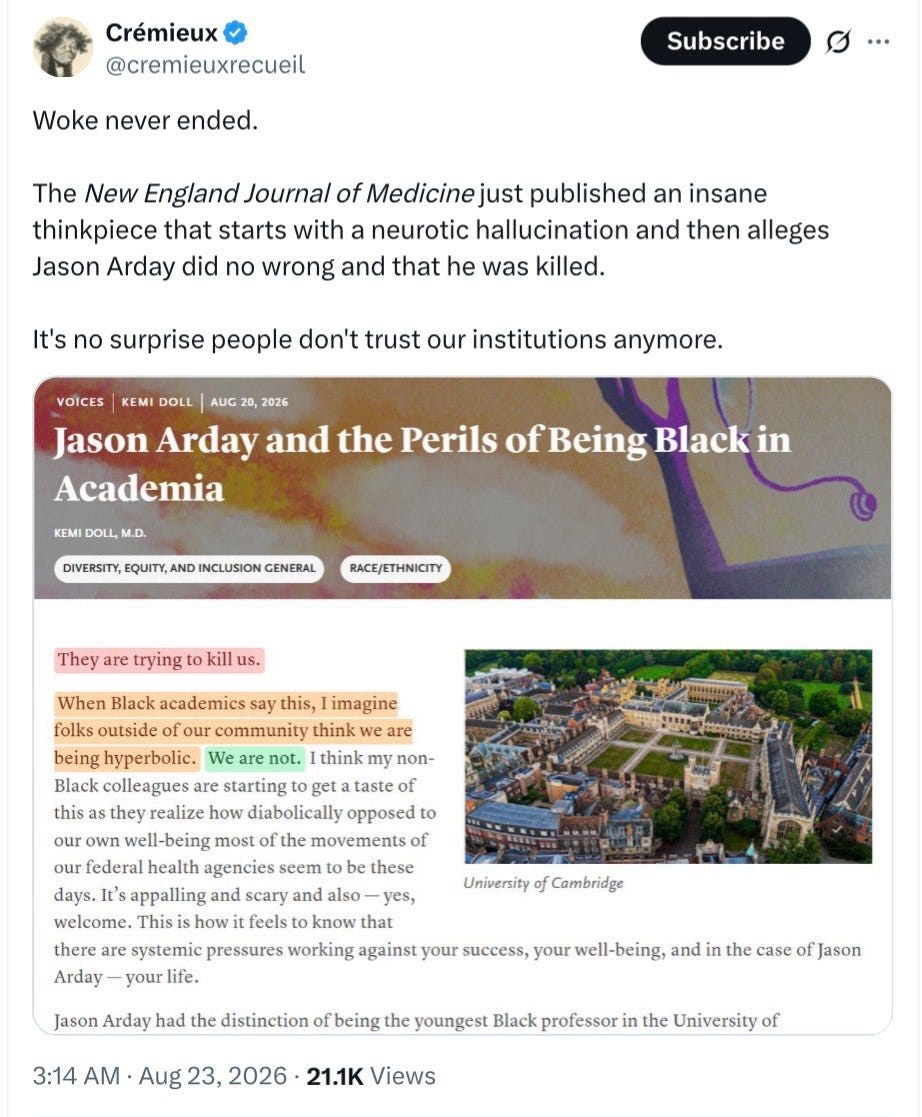
There is a real push to put the truly awful into Affluent White Female Urban Liberal. It’s almost as if there are some issues with feminisation. On the other hand, a woman being an open supporter of Lindsay Clancy is an excellent negative signal for men.
Just when you think progressivist purity spirals can’t get any worse, they do. Thus, we not only get the above hagiographical elevations of the grotesquely unworthy, we also see the physical mutilations of trans-surgery used to rehabilitate female genital mutilation.
But, of course, any such surprise is having far too contemporary a focus. Left-progressivism has a long history of elevating some of history’s most appalling monsters, most tyrannical mass murderers—Lenin, Stalin, Mao—as heroes of world-history and human liberation.
The use and abuse of moral mascots
The worse a group or individual behaves, the more progressives like them. If a group is noted for high levels of violence or various social dysfunctions, left-progressives adopt them as moral mascots.
The concept of such mascots comes from economist Thomas Sowell. Mascots are people or individuals that “the Anointed”—those who see themselves as at forefront of human liberation—adopt to be extolled and defended. This is connected to Thomas Sowell’s analysis of Constrained and Unconstrained political visions.
The Constrained Vision says there are no complete solutions, there are just trade-offs, all the way down. Human nature is one of those constraints. Biologist E. O. Wilson’s famous observation about Communism—great idea, wrong species—is a pithy expression of the Constrained Vision.
In the Constrained Vision, history is an enormous memory well where we learn about ourselves. This is because the humans who made history are just like us. Their experience, their triumphs and failures, even their mundanities, are lessons for us.
History is contingent, it has no particular direction. The Constrained Vision finds it easy to take people’s choices as having authority because there is no direction of historical travel to which they must conform.
The Unconstrained Vision denies that human nature is a constraint in that way, so it’s possible to create a society of transformative human liberation. History is not a source of lessons, but a record of failures to achieve that liberation—a record of corruption and sin.
Moreover, history has a proper direction—towards transformative human liberation or another, related telos. Hence, choices that support that direction are legitimate, those that go against it are not. The politics of the Unconstrained Vision turns elections into legitimating rituals: citizens’ votes are blocked from overturning any of the policies the Anointed have decided represent history’s proper direction.
The Anointed evince what writer Wesley Yang labels the non-electoral politics of institutional capture. If you want to see that in its most complete form among the Western democracies, PM Tony Blair’s debauching of Britain’s constitutional order through quangoes, human rights legislation that empowered judges over elected ministers, and devolving decision-making to the EU—thereby massively increasing the degree to which elections became legitimating rituals that change remarkably little—is the current gold standard case. However, all Western democracies face similar pressures, albeit to considerably differing degrees.
The commitment of The Anointed to this vision of human liberation gives them such a sense of trumping moral authority that they see themselves as owning morality. They have the right-to-decide what is moral and then to impose their decisions on everyone else.
This explains their willingness to wield cancel culture to block speech; to destroy reputations, careers, businesses; to enforce the continued movement of events in accordance with the correct arc of history. In extremis, that extends to simply killing those who oppose the correct direction of history—what the owners-of-morality decide is legitimate. Both Charlie Kirk and Ann Widdecombe were were murdered for their opinions, opinions which openly opposed the views that establish the moral heroism of the Anointed.
This generates a deep divide among those who see themselves as being on the left. Social democrats such as Mark Lilla, Matt Yglesias, Yascha Mounk, and Noah Smith are democrats (and patriots). They view their fellow citizens’ choices as having inherent authority. This is why they cannot stomach the politics of the Anointed, who are all too ready to judge the choices of their fellow citizens—indeed, to denigrate the concept and authority of citizenship—and seek to de-legitimise any choices that go against the moral vision of the Anointed.
The dismissal of national populists as “far right” and “fascist” is all about turning elections into legitimating rituals where only politics acceptable to the Anointed—who own morality—is legitimate and able to function.
History, however, does not have a direction and every attempt to create societies of transformative human liberation have been horrible failures. To adhere to the Unconstrained Vision requires a lot of not-noticing and rationalising away. But that becomes an active advantage in motivating and coordinating behaviour.
The more one has to not-notice or rationalise away to adhere to a political and social Vision, the stronger is the social signal of commitment to that Vision. More specifically, the stronger the mutual commitment to their pose of profound—indeed, socially transformative—moral heroism.
As part of this we see the creation of a DEI/EDI moral hierarchy where coloured has higher status than white; female higher than male; trans higher than cis; gay (or better queer) higher than straight; disabled higher than not; neurodivergent higher than neurotypical; and so on. This commitment to a moral hierarchy has an effect that such social visions always do: it substitutes myth for history. Past and present have to be framed to support an image of themselves as moral heroes and to preserve a hierarchical status game. Hence we get cartoon (simplified) and caricature (distorted) history to maintain the status hierarchy.
This status hierarchy then manifests in behaviours like two-tier policing, seen in the appalling case of the murder of Henry Nowak, where the coloured murderer calling “racism” was preferentially treated by police over his white (dying) victim. It is part of the not-noticing and rationalisation game that the Anointed deny there is anything such thing as two-tier policing.
Part of the attempt to portray Jason Ardray as a martyr is to condemn any attacks on him as racism. Attempts to hold individuals whose group scores highly in the DEI status hierarchy to even quite basic standards is construed as bigotry. This is what Eric Kaufmann characterises as:
the making sacred of historically marginalised race, gender and sex identity groups.
This use of moral abuse (and the fear of such use) is a key feature of the systematic institutional cowardice that debauches standards in the first place—“inclusion” being the self-righteous cover for such cowardice.
Note, however, this group sacredness only applies when it supports the pose of moral heroism. A member of such an allegedly sacred group loses all protection if he or she dissents from, or undermines, the piety displays that show one to be a member of the Anointed in good standing. Hence Republican Larry Elder becomes a Black face of white supremacy while economist Roland Fryer—a serious scholar and researcher whose life story is everything Jason Arday’s was not—was targeted after he published research inconvenient to the Black Lives Matter narrative.
A key part of the dynamic in contemporary society is that there are zealots—true believers—as well as fellow travellers, with the two connected by a shared status game that can obscure what the latter are fellow travellers to. Precisely because the Vision of the Anointed involves an ever-evolving set of linguistic taboos—and the required patterns of not-noticing and rationalising away—it provides an excellent status game for Western elites. It differentiates them from the benighted masses.
All of this is bad for culture, both popular and not. It is bad for comedy—which rests on disruptive noticing—and story-telling, as you do not get fleshed-out characters. You get avatars of identity, while cultural resonance is replaced by homogenising (and flattening) “inclusive” box-ticking. The pose of moral heroism leads directly to a lack of respect for canon—for the source material for TV and film adaptations—as that represents the corrupt and sinful past that writer and show-runner moral heroes are so ready to “improve”. This explains the trashing of various entertainment franchises and the pissing-away of Hollywood’s audience appeal.
Trans has become the epitome of these patterns, in both form and substance.
Those following the shared status game generated from the vision of the Anointed frame past, present and other people to support their pose of moral heroism. Trans not only provides excellent mascots because of how much one has to not-notice and rationalise away: men claiming Transwoman status insist that everyone go along with their framing of themselves as women while seeking to punish those who do not. Trans and the Anointed are co-conspirators in signalling self-serving poses of moral heroism.
Of course, the Trans push regularly runs into the biological realities of sex—most dramatically in sport. But so many of the proponents of the shared status game are members of the unaccountable classes—people who are paid to turn up, not for their performance. They do not have to make anything practical work, so they end up as permanent political adolescents, following an endless series of petulant political fads.
One of the conspicuous features of the reactions to the Jason Arday story is how those who have embraced the politics of the Anointed have displayed rage at their loss of narrative dominance. It represents a direct and public denial of their claim to own morality.
Whether it comes to violence among African-Americans and related cultural dysfunctions; the inconvenience of their lower average IQs or—in Western Europe—cousin marriage and its effects among Muslim immigrants; their jihadi issues; mass rapes; being a fiscal drag on their societies—whatever. Groups noted for bad or otherwise dysfunctional behaviour become moral mascots for left-progressives, for those following the Unconstrained vision; for following the politics of the Anointed. These groups noted for bad and dysfunctional behaviour are such powerful signals of shared moral heroism, not despite such bad or dysfunctional behaviour, but because of it.
Worse is better: the more that has to be not-noticed, the more has to be rationalised away, the stronger the social signal. As not-noticing and rationalising away becomes the mark of shared moral heroism, noticing then becomes a sign of moral villainy. This leads to self-righteous censoriousness and the shaming and shunning of dissent.
It is the same social dynamics that affirming strange and outré doctrines serve for religious cults.
The more people play this status game, the easier it is to join and the easier it is to enforce. These network effects—ramifying from a core of true-believer zealots—has generated “the long march through the institutions”.
This is also why immigration has become such a polarising issue. Not only does breaking up working-class communities (and so their social networks) advantage Western elites, so does pushing down wages and making capital relatively more scarce by importing low-skill labour. Meanwhile, much of the unaccountable classes directly live off “managing”—but never solving—social problems, so they benefit from increased social pathologies. The more dysfunctional a group, the better for all those who live by colonising social pathologies. There’s a reason for the Homeless Industrial Complex.
Moral posing
The great triumph of the left-progressive zealots has been to turn their politics into elite status games. But those status games have also been selected for because they are so congenial for so many Western elites. That is, they have become excellent mechanisms for university graduate Anywheres whose social connections are not rooted in a locality to parade their profound sense of superiority over the Somewheres whose social connections are rooted in their locality.
Prof. David Betz manages to express the consequences of these dynamics, including that of reducing elections to legitimating rituals.
Interviewer: How big of an issue is immigration in Europe right now?
Prof. David Betz: It’s a huge issue. The scale, the speed, and the composition of immigration into Western Europe since the late 1990s, and especially since 2015, has no peace-time precedent in in world history. Entire urban districts in Britain, France, Sweden, the Netherlands, Belgium—you name it—have been demographically transformed within a single generation and in many of these places, the historic native population is already a minority or is rapidly becoming one.
Parallel social norms predominate in these places, and the state’s monopoly of violence is, in practice, negotiated rather than absolute as it once was. So that’s not diversity in the American sense of gradual incorporation into a large essentially rather absorptive settler society. It’s the rapid creation of competing demographic and cultural blocs inside previously homogeneous nation states.
The political system in these countries has proved incapable of controlling the inflow, or of enforcing assimilation, at anything like the required scale. The result of this is not a temporary adjustment problem but a structural transformation of the demographic and political balance in these countries.
So Americans who view immigration primarily through the—and Canadians for that matter—who view immigration primarily through the lens of labor markets or humanitarian obligation and the like often underestimate how quickly the European experience has moved from policy disagreement into questions of sovereignty, parallel legal orders, and the long-term historical survival of these nations themselves.
Interviewer: Okay, thank you. That’s a very helpful answer. Now, you talked about how a lot of Europeans perceive that politicians aren’t capable or aren’t interested in addressing these issues. Maybe ‘interested’ is a better better term because you also talked about how these guys are post-national and don’t really care about their own national sovereignty or at least don’t guard it with the same sense that a lot of their citizens maybe would like it to be guarded. And I want to get your perspective on that because you’ve also written at various points about how the perception that political elites are incapable of addressing issues is one of the big pieces of tinder that can lead to civil conflict and that’s an interesting point because it’s not just that you have big issues and it’s not even just that the politicians are incapable of it or of addressing those issues I should say, but it is the widespread perception that they are not capable of doing. And that’s something that I’ve noticed a big uptick in my lifetime. So I was wondering if you could talk about that both why is that such a problematic factor and also why has there been such an increase in that kind of rhetoric about how politicians are useless? They don’t care about us. They’re not addressing our concerns. Why have we seen such a such an increase in that kind of talk?
Prof. David Betz: Yeah, there’s a very simple answer to this question of the rise in the perception of elite fecklessness among the general public and that is because the elites have been feckless on the issues that matter most to ordinary citizens. We’re talking about borders, their physical safety, their cultural continuity, and the equal application of the law. So, when people, are expressing upset about two-tier justice, for example, that’s what I’m talking about.
Well, at the same time, these same elites demonstrate great energy and competence in protecting their own interests and progressive priorities. The same governing class that can’t stop small boat crossings. In fact, we can’t even call that small boat crossings anymore. The last boat to arrive on British shore had 230 people on it, something like that. This is not a small dingy. They can’t protect working-class girls from organized rape networks, but they can mobilize very swiftly to police speech. They can expand surveillance of the native population. They can rearrange the institutional landscape to lock in their preferences and so on and so forth.
This selectivity on the part of elites is very visible and it is experienced by normal people as contempt. They feel that their elites treat them contemptuously and basically they’re correct in that assessment.
‘Managerial containment’ is what I call it, which is essentially how I would describe what the elites are doing. If I were to give two words to describe their strategy it would be ‘managerial containment’. That’s just the operational expression of this selective fecklessness. Problems are managed as public relations and procedural challenges, rather than solved.
The elevation of the grotesquely unworthy as martyrs—objectionable in itself—is part of a much wider, and more destructive, pattern. A society cannot have well-functioning institutions if it does not have the normative coherence, the strong enough civic culture, to enforce the norms and rules that make for well-functioning institutions.
Don’t murder your children; don’t parade a pack of lies as your life-history: really, these are not difficult standards to grasp and enforce. Unless, of course, what really matters is striking poses of moral heroism. We in the West have entire networks—indeed institutions of so-called education—where such moral voguing is not only all the rage, it is close to compulsory. That last piece—by Cambridge graduate Max Klinger—documents yet another situation where an able undergraduate spent years having to lie for marks.
Of course academic journals end up publishing trash. Such moral voguing is used to attack the very idea of academic standards, turning concern for standards into a push to kill black academics.
The solution is becoming increasingly obvious: dissolve the universities. Separate out STEM (including evolutionary—but not cultural—anthropology) and law (excising international not-really-law), defund the rest.
References
Donald E. Brown, Hierarchy, History & Human Nature: the Social Origins of Historical Consciousness, University of Arizona Press, 1988.
Ben Cobley, The Tribe: The Liberal-Left and the System of Diversity, Societas essays in political & cultural criticism, Imprint Academic, 2018.
David Goodhart, The Road to Somewhere: The New Tribes Shaping British Politics, Penguin, 2017.
Mark Granovetter, ‘The Strength of Weak Ties: A Network Theory Revisited,’ Sociological Theory, Vol.1, 1983, 201-233. https://www.csc2.ncsu.edu/faculty/mpsingh/local/Social/f15/wrap/readings/Granovetter-revisited.pdf
Garett Jones, The Culture Transplant: How Migrants Make the Economies They Move To a Lot Like the Ones They Left, Stanford University Press, 2023.
Thomas Sowell, A Conflict of Visions: Ideological Origins of Political Struggles, Quill William Morrow, 1987.
Thomas Sowell, The Vision of the Anointed: Self-Congratulation as a Basis for Social Policy, Basic Books, 1999.
Will Storr, The Status Game: On Social Position And How We Use It, HarperCollins, 2022.
Warby of Oz hits the nail on the head, as usual. Brilliant deconstruction of the insanity and social parasitism of the woke/elite "left".
“The Vision of the Anointed
Self-congratulation as a basis for social policy.”
Thomas Sowell is famous for his aphorisms but how apt is that book title for the permanently offended, oppressed and victimised race warriors who have circled the wagons around their fallen idol and sallied forth to scapegoat and defenestrate someone suitable to bully and vilify.