


The first post in this series discussed how the ability of societies to absorb immigrants varies due to the characteristics of the society and of the immigrants. This includes cultural differences. Western individualism rests on the suppression of kin-groups (e.g. clans) whereas most human societies have been based, to a larger or lesser extent, around kin-groups.
The second post in this series examines how liberal individualism is a cultural construct, the dynamics of kin-groups, and how institutions are cultural creations.
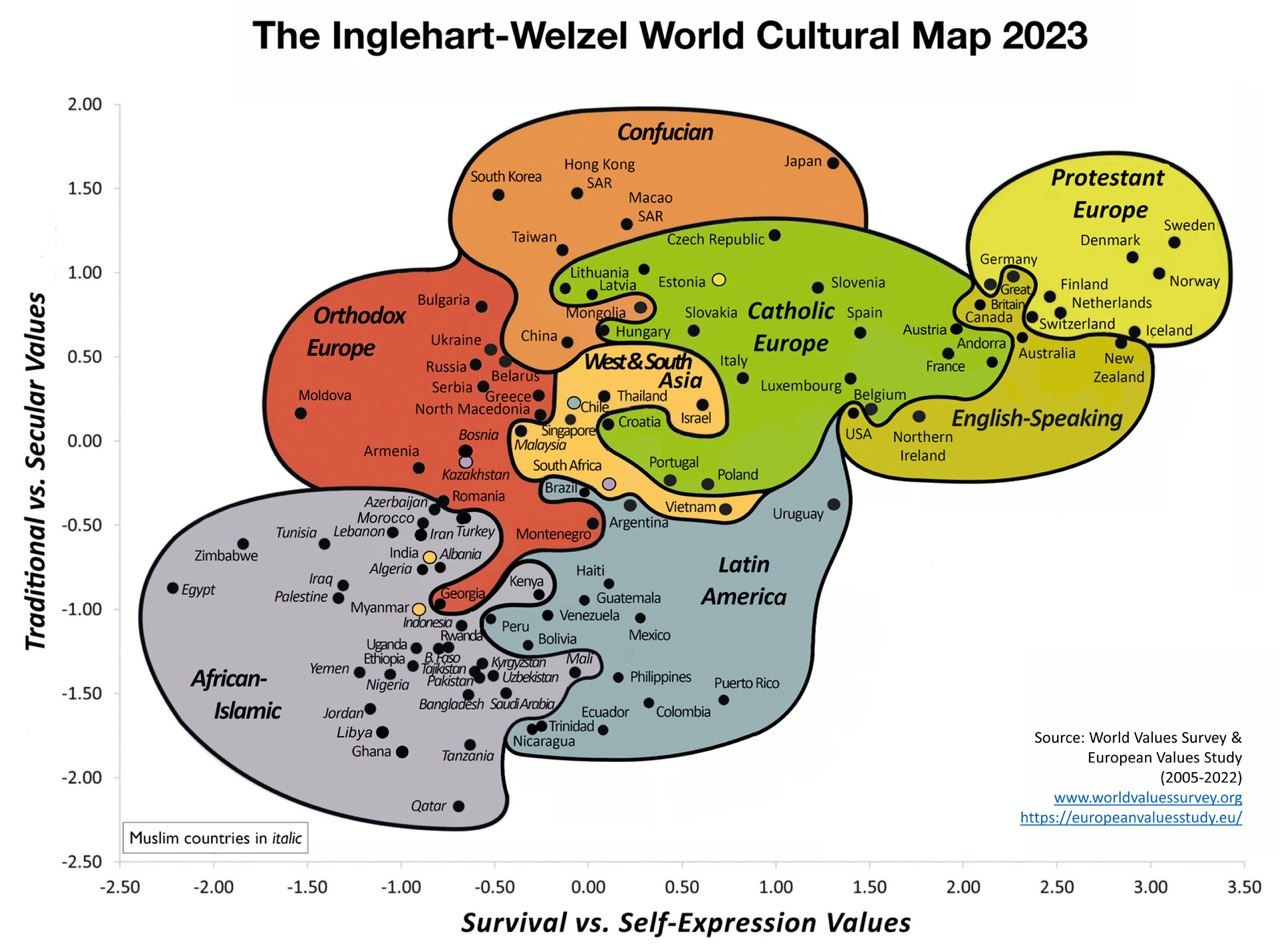
A striking feature of Western democratic politics in recent decades has been how conventional centre-right politics has been recurrently pushed aside by various forms of national populism. We have seen country-club Republicans get Trumped, Gaullists get Le Penned, Forza Italia get Melonied, the Tories are being Faraged, and now the Coalition in Australia is getting Hansoned, with immigration being, again and again, a key issue in those shifts.
There is also a recurrent response to this pattern: to treat it as political pathology. For some mysterious reason, a whole lot of—particularly working-class voters—have allegedly just gone feral. The default responses from this “it’s political pathology” analysis has been some mixture of censorship, de-legitimisation (“far right”) and would-be political quarantining.
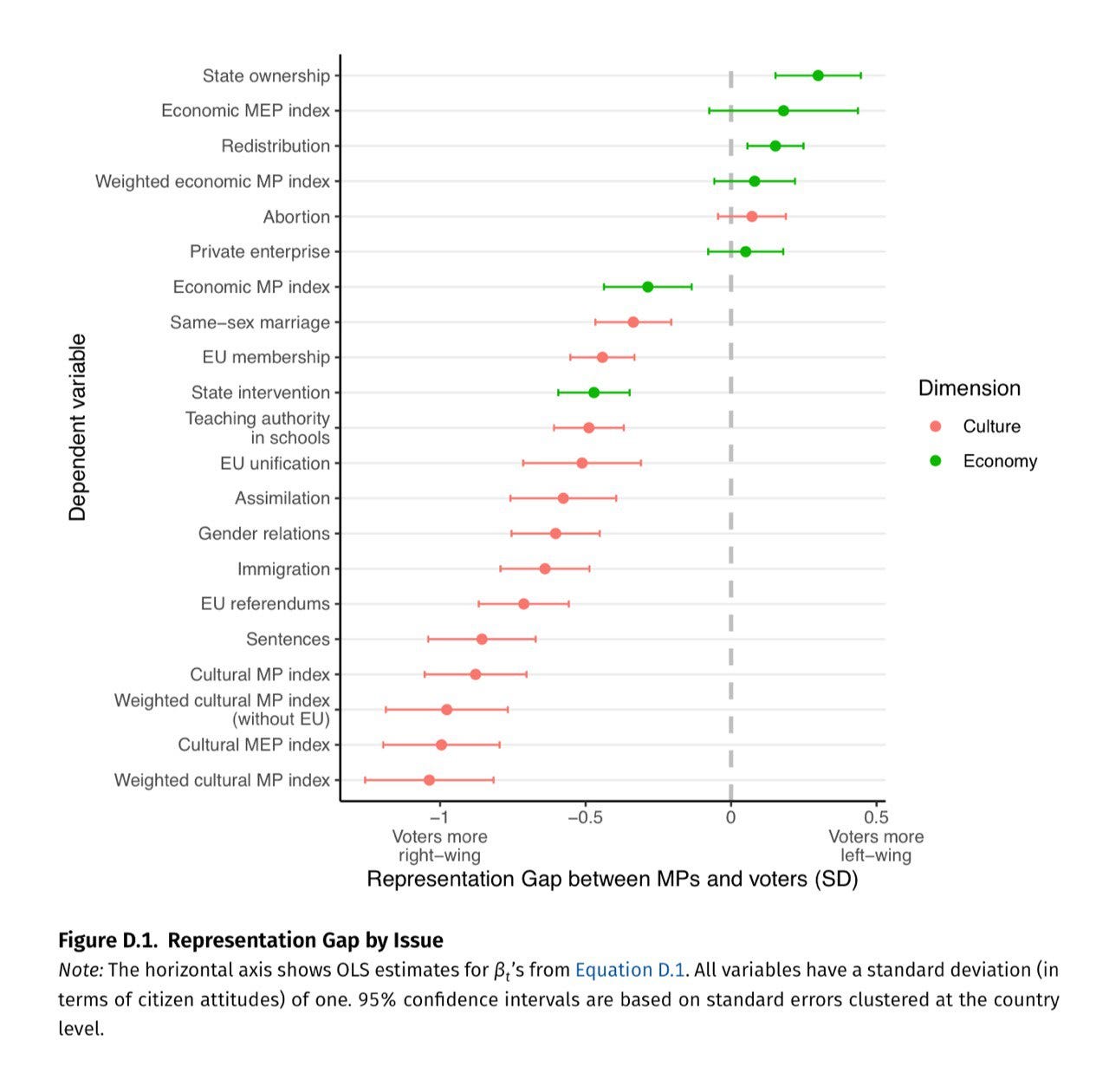
Such responses represent systematic attempts to stop democratic feedback from doing its thing. It is a striking pattern that, across Europe—while there is no systematic difference between politicians and voters on economic issues—there is a systematic difference on cultural issues, including immigration.
One might expect that economists—as their discipline prides itself on its rational actor analysis—might resist any “political pathology” analysis of the shift towards national populism in polity after polity. On the contrary, most mainstream economists and economic commentators—particularly in the US—have clearly decided that disagreeing with mainstream economists (especially on immigration) is a sign of irrationality (and probably moral inadequacy). This mixes American parochialism—ignoring European experience and debates—with academic arrogance.
The trouble with the response of mainstream economists is that they start with their Theory, use it to select what evidence they will pay attention to, and proceed from there. A much better approach is to start with history and decide which bits of Theory might be helpful in identifying and understanding the patterns we see.
The key mistake that economists make is they treat immigration as fundamentally an economic issue. This is a mistake that conventional centre-right politicians—taking their cue from the economists—have repeated. It is profoundly mistaken.
Immigration is fundamentally a cultural issue. Yes, immigration has economic implications, consequences, even reasons. But it remains fundamentally a cultural issue. Hence conventional centre-right politicians screwing up, in polity after polity, the fundamentally cultural politics of immigration.
Immigration is a matter of cultural politics for two reasons. First, we are a cultural species. People spend the first two decades of their life immersed in the culture of their family, social, and information networks long before they become significant economic transactors.
We humans cognitively map significance, not facts. We absorb cultural patterns of significance, cultural maps of meaning, from the family-and-social-networks culture we are raised in. The consequence is that people from different cultures in the same circumstances will behave differently, because cognitively, they are not the same circumstances—because humans cognitively map significance, not facts.
As I discuss in this post, formally similar institutions can and do operate quite differently in different cultures. Such differences can extend even to things with such brutal feedback effects as military performance.
Immigrants simply are not interchangeable “economic agents”. Their cultural distance from the receiving society—and the norms and rules its institutions are based on—matters. It does not help that academics—as part of their status games—recurrently misconstrue popular reactions to cultural distance as “racism”.
Norms and rules
The other reason immigration is fundamentally a cultural question is because institutions are central to how societies operate, and therefore their ability to successfully absorb immigrants. Institutions—even institutions with economic functions and purposes—are fundamentally cultural creations. This is why formally similar institutions operate differently in different cultures.
Institutions work because their norms and rules are effective and are followed. While those rules and norms may be somewhat self-reinforcing, they have to be robust against pressures to evade those norms and rules, or to follow different norms, different rules. The more congruent the cultures of immigrants are with the institutional norms and rules of the receiving society, the less pressure immigration imposes on those institutions. The less congruent the cultures of immigrants are with those norms and rules, the more pressure on institutions.
As cultural distance would predict—and as we can observe—large-scale Muslim immigration puts Western institutions, based on highly individualistic cultural patterns, under particular strain, as discussed in the previous post. We can even observe large-scale immigration tending to fracture receiving countries—the US, the UK, France—along their provincial/metropolitan divides: divides which are also, in part, cultural.
So, part of the immigrant absorption issue—how successfully for the citizenry, and the successful functioning of its institutions, a given society absorbs immigrants—is how congruent the cultures of immigrants are with the norms and rules of local institutions. One way to enable such congruence is to have lots of small groups of immigrants rather than large “lumps”, as the larger the “lumps”, the easier it is to remain immersed in—and so retain—one’s original cultural patterns. The smaller the groups, the less immersed in one’s original cultural patterns, the more adaptation to the local civic culture there is likely to be.
This is why it is deeply, deeply stupid to see immigration as simply about gains-from-trade in societies conceived as arenas for free-floating transactions where gains-from-trade efficiency is the key issue. Any politicians who take their cue from the Theory-driven delusions of economists that immigration is primarily an economic issue will, sooner or later, get seriously wrong-footed by how much immigration is fundamentally a matter of cultural politics and cultural pressures—a pattern we have now seen in polity after polity. The repeated failure of conventional centre-right politics is not because those politicians did not listen to economists: it is because they did.
It is particularly stupid of American economists to carry on like this. Not only did Robert Fogel—1992 Nobel memorial laureate in Economics—publish an entire book (Without Consent or Contract) on how mass immigration broke the American Republic along its fault-line of slavery. Not only were indigenous Americans dispossessed by invading immigrants, so was the Mexican state (of its northern territories) by Anglo immigrants to Mexico organising to separate themselves from Mexico. This is without noting how Palestinian immigration led to a brief civil war in Jordan and a long one in Lebanon.
Civil war, mass rapes and sexual exploitation (remembering that Islam sanctifies rape), corrosion of institutions: these are observable consequences of mass immigration. Yes, it is remarkably arrogant of American economists to so ignore the European experience with, and debates about, immigration. But that is classic American parochialism. It is the historical illiteracy about their own country’s history that is ridiculous.

The thicker your attention to history—in all its complexities and contingencies—the thinner your general Theory has to be. Conversely, the thicker your Theory—the more it selects for what you do and do not pay attention to, and how you construe it—the thinner your sense of history.
So much of the ambient analytical stupidity about immigration is Thick Theory and thin history: Thick Theory in both senses of thick.
Ironically, the systematic analytical incompetence of mainstream economics about immigration is, in itself, a sign of how much immigration is a cultural issue. Yes, part of the problem is Samuelsonian “social physics” Economics with humans as interchangeable “economic particles”. However, a lot of the analytical failure is from how mainstream Economics acts as an epistemic community where being positive about immigration—which entails not noticing how it can be done really badly—marks one as being a member of the epistemic community of Serious economists In Good Standing.
Saying one favours immigration is as silly as saying one favours monetary policy. It requires an utterly impoverished sense of how the thing can be done badly.
A large part of Western elite cluelessness about immigration is from the adoption by so much of mainstream media of the Pravda-media-model—of being in the business of selling narratives of righteousness; of what you have to accept to be a “good” person, a “smart” person, an informed person. Since being pro-immigration is a marker of being “smart” and “good”, the mainstream media coverage of immigration issues tends to be highly selective.
Allegedly informed Americans can be startlingly ignorant of, for example, European experience and debates on immigration in a way that, for example, people in Japan are not. Allegedly “informed” Americans are likely to be completely ignorant of the increasing contempt they and their discipline are held in within Europe by those who have observed how analytically inadequate—indeed incompetent—their treatment of immigration has been.
Moreover, any pre-determined correctness is hostile to genuine political and social bargaining. Elite status-games based on the moral and cognitive splendours in elite heads—so on pre-determined correctness—are profoundly hostile to any inconvenient information that undermines such status and authority claims. That means they are also hostile to any inconvenient democratic feedback.
Raising concerns about immigration is perennially subject to moral abuse that protects beliefs as markers of righteousness. It is also subject to the thought-terminating cliche of “far right” and similar terms.
Globalisation complications
As discussed in the two previous posts, across human societies, the main mechanisms for cooperation have been based around either lineage (kin-groups) or locality. Globalisation creates cooperation-and-connection networks not based on either locality or lineage. The people who are embedded in such transnational networks social analyst David Goodhart calls the Anywheres.
These neither locality-nor-lineage networks have come to operate on an updated version of the third great mechanism of connection: a secularised version of the ritual-and-belief coordination historically provided by sects and religions. This is the adoption of shared markers of righteousness, shared elite signals of belief.
The dynamics by which network goods tend to be monopoly goods—the larger the network, the greater the benefits of membership and the cheaper it is to add an extra person—encourage social networks to coalesce around shared moralised status games based on performative beliefs. If affirming X is the politics of ostentatious compassion, then holding not-X must be the politics of “hate”. The more people in a social or institutional milieu play such status games, the more acquiescence in such cognitive exclusions spreads via such network-monopoly effects.
The more a cause is obviously transnational, the more it is grist for networks that are based on neither lineage nor locality. Climate change—whatever the scientific realities—is made for such networks. But any cause that does not come tied to a locality will do—Trans, for example. Or supporting mass immigration. The last especially works because the costs of immigration vary so enormously by locality, with the costs generally not falling on localities where Anywheres live.
The more people are insulated from the consequences of being wrong about reality, the more such status games will appeal. Apart from anything else, it makes it that much easier to shame and shun people for dissenting—regardless of how accurate about reality their dissent might be. Indeed, the more you have to not-notice and rationalise away, the stronger the signal of commitment to the in-group is.
The social consequence of defecting from the shared moralised status-games have to matter more than the consequences to those playing the status games of the claims not being true. Hence, this is very much the politics of the unaccountable classes, of those paid to turn up. It is the politics of bureaucracy, of content-free management, of non-profit organisations, of academe, of teachers, of activists, of reality-editing zealots.
If one does not have to adjust to inconvenient information—because, for example, one is paid by coerced income—then authority-increasing status claims are going to be favoured. If beliefs are not reality-tested, but income is vulnerable to elite status games, then that encourages conformity as well.
It is precisely because the unaccountable classes are shielded from reality in various ways that status-based social feedback from within their networks becomes dominant. But wealth can have the same insulating effect.
The effect of these expanding global elite networks is to sharpen the divide between global-networks elites and those whose networks—whose social capital—is overwhelmingly locality-based: the Somewheres. This is why conventional centre-right politicians—themselves typically Anywheres, hiring Anywheres as staffers, and interacting with mainstream media dominated by Anywheres and their concerns—regularly screw up cultural politics, especially regarding immigration.
Mainstream Economics’ impoverished sense (it is just about commerce and efficiency) of social cooperation mechanisms—and what makes a successful society—has proved to be an excellent intellectual weapon on behalf of the Anywheres against the Somewheres. Economists themselves are, of course, typically Anywheres.
This dynamic of Anywheres elites dominating policy against the interests of increasingly alienated Somewhere voters is very much part of the dynamics of contemporary Western politics. National populism lives off it. Anti-elite politics makes a lot more sense when the elites are functionally out to get you.
The EU is an Anywhere creation and project. By putting commitment to “Ever Closer Union” into its founding documents, the EU has embraced a principle that justifies Anywhere elites—led by the Anywhere Eurocrats—de-legitimising any vote, any electoral response by Somewheres, that pushes back against “Ever Closer Union”.
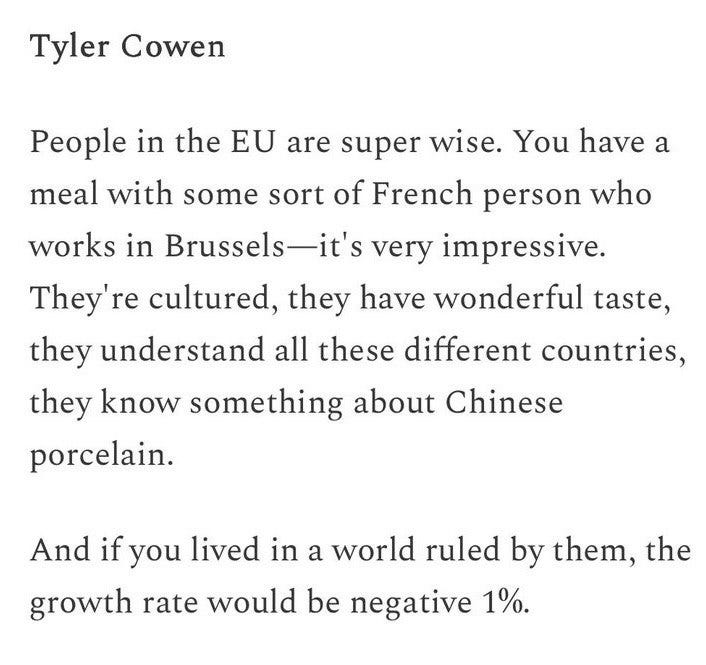
The EU has become a structure of institutionalised social aggression against its working class Somewheres. The EU elites’ demand for discourse control—as part of this endemic de-legitimisation of the inconveniently demotic—continues to poison relations with European Somewheres, and with any American expression of Somewhere concerns.
The delegitimisation of dissent; the culturally corrosive effects of immigration; and of various elite agendas, are then deeply corrosive to maintaining the Transatlantic alliance. This is a corrosive pattern that so many Very Serious People fail to acknowledge, and one suspects utterly fail to even notice. After all, they live within Anywhere networks into which Somewhere concerns do not intrude, except as something to scoff at or catastrophise about.
Democracy is supposed to provide a corrective to such elite arrogance. Alas, modern Anywheres—greatly aided by the Critical Theory magisterium that increasingly dominates universities and generates anti-democratic-feedback elite status-games—continue to develop mechanisms to block the feedback that democracy relies on and is supposed to provide. Instead, we get what writer Wesley Yang accurately describes as non-electoral politics of institutional capture.
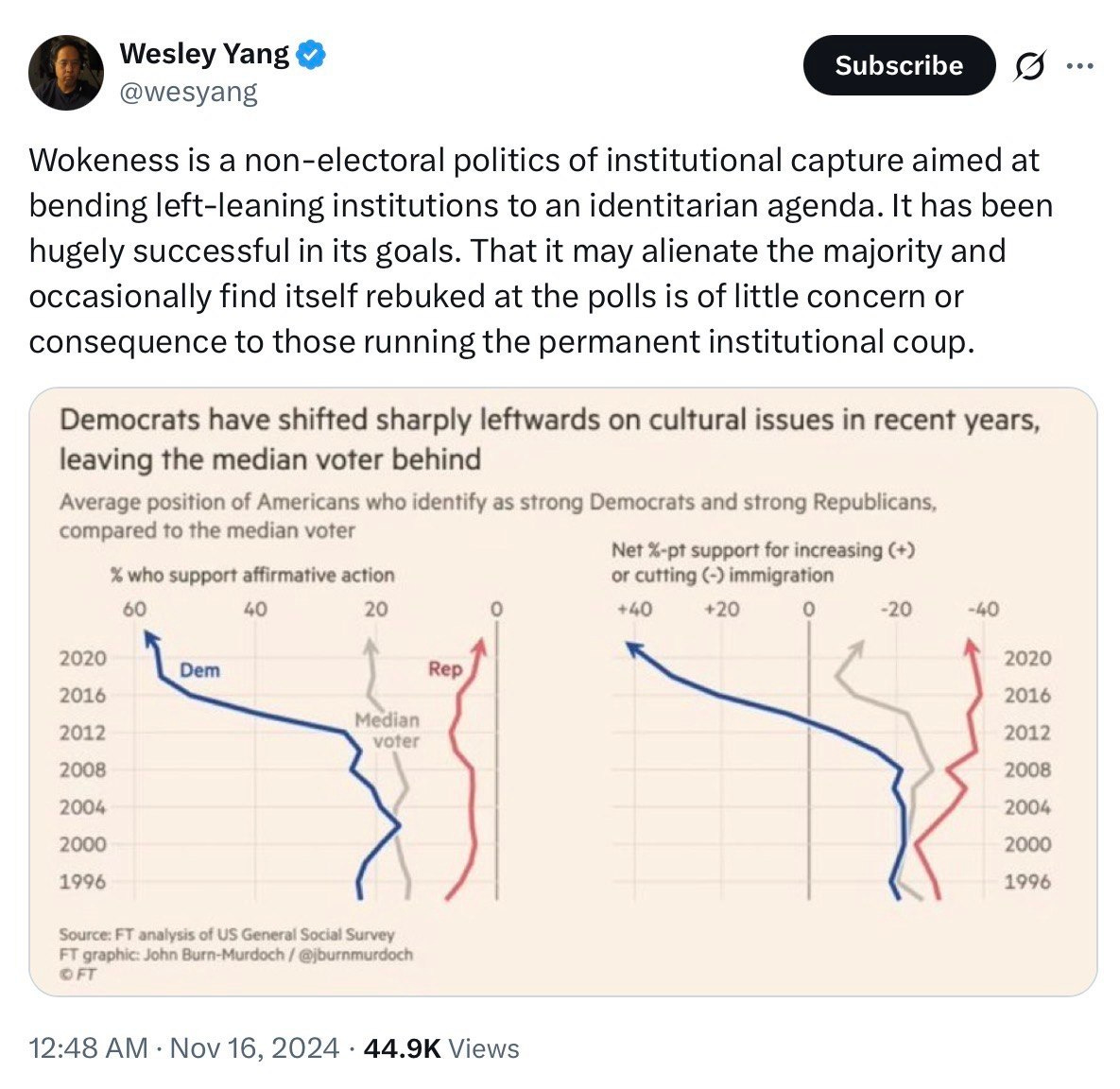
De-legitimising Somewhere and other dissenting feedback is something that many mainstream economists have proved to be destructively complicit in via their historically illiterate—and profoundly impoverished—understanding of what makes for successful societies. No, commerce and efficiency are not enough on their own: not even close.
A sign of how much policy incompetence has become a feature of Western elites—due to using beliefs as markers of righteousness—is the simultaneous support for mass immigration and Net Zero. Net Zero means raising the price of, and restricting access to, energy. Cheap, reliable energy is fundamental to mass prosperity—it is far more important than, for example, free trade.
Piling more people into a country while raising the price of energy means increasing contestation over resources and narrowing the range of sustainable economic activity. Only folk who are profoundly insulated from reality-tests could embrace such a nonsense combination.
The analytical incompetence of mainstream Economics regarding immigration is crucial here. Forgetting Thomas Sowell’s dictum that there are no solutions, only trade-offs, mainstream economists have utterly failed to produce useful models of the constraints on immigrant absorption that would enable weighing against policy choices.
To create such models would require acknowledging institutional and other limitations to the ability to absorb immigrants. It would require a comprehensive look at the mechanisms of cooperation in successful polities and societies—not as mere economies and not only commerce. It would require considering resilience—the ability to adapt to changing circumstances—not only efficiency. It would require not treating immigrants as interchangeable widgets. It would require not treating immigrants as the only Homo sapiens in human history who cannot make things worse. It would require taking our existence as cultural beings seriously. It would requiring noticing we are evolved beings and what evolutionary biology and evolutionary anthropology tell us about humans as social actors.
The pressure to de-legitimise
It would require noticing that the more pressure from within the society there is to de-legitimise the existing norms and rules of the society, its institutions and civic culture—something the the Critical Theory magisterium is committed to—the more corrosion of local institutions there will be. The more local elites are willing to compromise those norms and rules—e.g. to get votes and/or cash-in on various political patronage possibilities—the more corrosion of institutions there will be. Minnesota is currently providing a text book case.
The pose whereby highly credentialed people in responsible positions make a display of being “subversive” is just a way of being self-righteously irresponsible: nothing is our fault, we do not have to grow up. The associated elite status games actively reduce the ability of societies to absorb immigrants precisely because they undermine commitment to the norms and rules which generated high-functioning (and high-trust) societies in the first place.
Left-progressive politicians, bureaucrats (whether government, corporate, or in non-profits) and mainstream media—all those who play the elite status games generated by the Critical Theory magisterium—cannot be trusted to uphold or respect rules and norms of key institutions. On the contrary, they are corrosive of the same and clearly and openly use immigrants as an excuse to be so (see “decolonisation”). Thus, the more institutional influence left-progressivism—and its status-games—has, the lower the capacity to successfully absorb immigrants and the more Western democracies need to become restrictive about the scale of immigration, and selective about which immigrants are taken in.
Immigration is primarily a cultural issue. Unless and until folk understand that; until public discourse is able to wrestle with it—and the decay of democratic feedback mechanisms is reversed—mass immigration is going to continue to be a mechanism to unravel Western democracies by corroding their institutions and their civic cultures.
References (for parts I-III)
Mikael S. Adolphson, The Gates of Power: Monks, Courtiers, and Warriors in Premodern Japan, University of Hawaii Press, 2000.
M. Ajaz, N. Ali, G. Randhawa, ‘UK Pakistani views on the adverse health risks associated with consanguineous marriages,’ Journal of Community Genetics, 2015;6(4):331-342. https://pmc.ncbi.nlm.nih.gov/articles/PMC4567984/
Plamen Akaliyski, Vivian L. Vignoles, Christian Welzel, & Michael Minkov, ‘Individualism–collectivism: Reconstructing Hofstede’s dimension of cultural differences,’ Journal of Personality and Social Psychology, (2025). Advance online publication. https://www.researchgate.net/publication/398587882_Individualism-Collectivism_Reconstructing_Hofstede’s_Dimension_of_Cultural_Differences
Alberto Alesina and Paola Giuliano, ‘Culture and Institutions,’ Journal of Economic Literature,2015, 53(4), 898–944. https://www.aeaweb.org/articles?id=10.1257/jel.53.4.898
Scott Atran, ‘“Devoted Actor” versus “Rational Actor” Models for Understanding World Conflict,’ Briefing to the National Security Council, White House, Washington, DC, September 14, 2006. https://core.ac.uk/download/pdf/6801978.pdf
Scott Atran, Robert Axelrod, Richard Davis, ‘Sacred Barriers to Conflict Resolution,’ Science, Vol. 317, 24 August 2007, 1039-1040.https://www.researchgate.net/publication/6123217_Sacred_Barriers_to_Conflict_Resolution
Ayaan Hirsi Ali, Prey: Immigration, Islam, and the Erosion of Women’s Rights, HarperCollins, 2021.
Patricia Balaresque, Nicolas Poulet, Sylvain Cussat-Blanc, Patrice Gerard, Lluis Quintana-Murci, Evelyne Heyer & Mark A. Jobling, ‘Y-chromosome descent clusters and male differential reproductive success: young lineage expansions dominate Asian pastoral nomadic populations,’European Journal of Human Genetics, 23, 1413–1422 (2015).https://www.researchgate.net/publication/270966126_Y-chromosome_descent_clusters_and_male_differential_reproductive_success_Young_lineage_expansions_dominate_Asian_pastoral_nomadic_populations
Christopher I. Beckwith, Empires of the Silk Road: A History of Central Eurasia from the Bronze Age to the Present, Princeton University Press, 2009.
Christopher I. Beckwith, The Scythian Empire: Central Eurasia and the Birth of the Classical Age from Persia to China, Princeton University Press, 2023.
Abdulbari Bener, Ramzi R. Mohammad, ‘Global distribution of consanguinity and their impact on complex diseases: Genetic disorders from an endogamous population,’ The Egyptian Journal of Medical Human Genetics. 18 (2017) 315–320. https://www.researchgate.net/publication/315370839_Global_distribution_of_consanguinity_and_their_impact_on_complex_diseases_Genetic_disorders_from_an_endogamous_population
Chris Bidner & Mukesh Eswaran, ‘A gender-based theory of the origin of the caste system of India,’ Journal of Development Economics, Elsevier, 2015, vol. 114(C), 142-158.https://economics.ubc.ca/wp-content/uploads/sites/38/2014/05/pdf_paper_mukesh-eswaran-gender-based-theory-origin.pdf
Ben Cobley, The Tribe: The Liberal-Left and the System of Diversity, Societas essays in political & cultural criticism, Imprint Academic, 2018.
Roger Eatwell and Matthew Goodwin, National Populism: The Revolt Against Liberal Democracy, Pelican, 2018.
Amory Gethin, Clara Mart´inez-Toledana, Thomas Piketty, ‘Brahmin Left Versus Merchant Right: Changing Political Cleavages In 21 Western Democracies, 1948–2020,’ The Quarterly Journal Of Economics, Vol. 137, 2022, Issue 1, 1-48. https://academic.oup.com/qje/article/137/1/1/6383014
Musa al-Gharbi, We Have Never Been Woke: The Cultural Contradictions of a New Elite, Princeton University Press, 2024.
Herbert Gintis, Carel van Schaik, and Christopher Boehm, ‘Zoon Politikon: The Evolutionary Origins of Human Political Systems’, Current Anthropology, Volume 56, Number 3, June 2015, 327-353. https://pubmed.ncbi.nlm.nih.gov/29581024/
Ryan James Girdusky and Harlan Hill, They’re Not Listening: How the Elites Created the National Populist Revolution, Bombardier Books, 2020.
Edward L. Glaeser, Andrei Shleifer, ‘The Curley Effect: The Economics of Shaping the Electorate,’The Journal of Law, Economics, and Organization, Volume 21, Issue 1, April 2005, 1–19. https://www.nber.org/system/files/working_papers/w8942/w8942.pdf
Zach Goldberg, ‘How the Media Led the Great Racial Awakening,’ Tablet, August 05, 2020.
https://www.tabletmag.com/sections/news/articles/media-great-racial-awakening
David Goodhart, The Road to Somewhere: The New Tribes Shaping British Politics, Penguin, 2017.
Mark Granovetter, ‘The Strength of Weak Ties: A Network Theory Revisited,’ Sociological Theory, Vol.1, 1983, 201-233. https://www.csc2.ncsu.edu/faculty/mpsingh/local/Social/f15/wrap/readings/Granovetter-revisited.pdf
Laurenz Guenther, ‘Political Representation Gaps and Populism,’ February 3, 2025. https://papers.ssrn.com/sol3/papers.cfm?abstract_id=4230288
Jonathan Haidt and Jesse Graham, ‘Planet of the Durkheimians, Where Community, Authority, and Sacredness are Foundations of Morality,’ December 11, 2006. https://papers.ssrn.com/sol3/papers.cfm?abstract_id=980844
Max Hartshorn, Artem Kaznatcheev and Thomas Shultz, ‘The Evolutionary Dominance of Ethnocentric Cooperation,’ Journal of Artificial Societies and Social Simulation, (2013) 16 (3) 7. https://jasss.soc.surrey.ac.uk/16/3/7.html
Bryan Hayden, The Power of Ritual in Prehistory: Secret Societies and the Origins of Social Complexity, Cambridge University Press, [2018] 2020.
Joseph Henrich, The Secret of Our Success: How Culture Is Driving Human Evolution, Domesticating Our Species, And Making Us Smarter, Princeton University Press, 2016.
Max Horkheimer, ‘Traditional and Critical Theory,’ in Critical Theory: Selected Essays, (trans. Matthew O’Connell and others), Continuum Publishing, [1937] 1982, 188-243. https://blogs.law.columbia.edu/critique1313/files/2019/09/Horkheimer-Traditional-and-Critical-Theory-2.pdf
Yasheng Huang, The Rise and Fall of the East: How Exams, Autocracy, Stability, and Technology Brought China Success, and Why They Might Lead to Its Decline, Yale University Press, 2023.
Garett Jones, The Culture Transplant: How Migrants Make the Economies They Move To a Lot Like the Ones They Left, Stanford University Press, 2023.
Monika Karmin, et al., ‘A recent bottleneck of Y chromosome diversity coincides with a global change in culture,’ Genome Resources, 2015 Apr;25(4):459-66. https://pmc.ncbi.nlm.nih.gov/articles/PMC4381518/
Eric Kaufmann, Whiteshift: Populism, Immigration and the Future of White Majorities, Penguin, 2018.
Debin Ma, ‘Rock, scissors, paper: the problem of incentives and information in traditional Chinese state and the origin of Great Divergence,’ Economic History Working Papers 37569, London School of Economics and Political Science, Department of Economic History, 2011.https://www.lse.ac.uk/Economic-History/Assets/Documents/WorkingPapers/Economic-History/2011/WP152.pdf
Debin Ma & Jared Rubin, ‘The Paradox of Power: Principal-agent problems and administrative capacity in Imperial China (and other absolutist regimes),’ Journal of Comparative Economics, (2019), 47(2), 277-294. https://digitalcommons.chapman.edu/esi_working_papers/212/
Peter McLoughlin, Easy Meat: Inside Britain’s Grooming Gang Scandal, New English Review Press, 2016.
Herbert Marcuse, ‘Repressive Tolerance,’ in A Critique of Pure Tolerance, Robert Paul Wolff, Barringon Moore Jr., and Herbert Marcuse, Beacon Press, 1965. https://www.marcuse.org/herbert/publications/1960s/1965-repressive-tolerance-fulltext.html
Jacob Moscona, Nathan Nunn, and James A. Robinson, ‘Keeping It in the Family: Lineage Organization and the Scope of Trust in Sub-Saharan Africa,’ American Economic Review 2017, 107 (5): 565–71. https://papers.ssrn.com/sol3/papers.cfm?abstract_id=2924286
Stephanie Muravchik, Jon A. Shields, Trump’s Democrats, Brookings Institution Press, 2020.
K.W. Nicholls, Gaelic and Gaelicized Ireland in the Middle Ages, Lilliput Press, [1971] 2012.
Nathan Nunn, ‘Culture And The Historical Process,’ NBER Working Paper 17869, February 2012. http://www.nber.org/papers/w17869
Jordan Peterson, Maps of Meaning: The Architecture of Belief, Routledge, 1999.
Kenneth M. Pollack, Armies of Sand: The Past, Present, and Future of Arab Military Effectiveness, Oxford University Press, 2019.
Philip Carl Salzman, Pastoralists: Equality, Hierarchy, And The State, Westview Press, 2004.
Philip Carl Salzman, Culture and Conflict in the Middle East, Humanity Books, 2008.
Tuan-Hwee Sng, ‘Size and dynastic decline: The principal-agent problem in late imperial China, 1700–1850,’ Explorations in Economic History, Volume 54, 2014, 107-127. https://conference.nber.org/confer/2011/CE11/Sng.pdf
Thomas Sowell, Knowledge and Decisions, Basic Books, [1980] 1996.
Kathleen Stock, Material Girls: Why Reality Matters for Feminism, Fleet, 2021.
Will Storr, The Status Game: On Social Position And How We Use It, HarperCollins, 2022.
Cass R. Sunstein, Why Societies Need Dissent, Harvard University Press, 2003.
Robert Trivers, The Folly of Fools: The Logic of Deceit and Self-Deception in Human Life, Basic Books, [2011], 2013.
Yuhua Wang, The Rise and Fall of Imperial China: The Social Origins of State Development, Princeton University Press, 2022.
Mark S. Weiner, The Rule of the Clan: What an Ancient Form of Social Organization Reveals About the Future of Individual Freedom, Picador, 2014.
Fei Xiaotong, From the Soil: the Foundations of Chinese Society, trans, with an introduction and epilogue by Gary G. Hamilton and Wang Zheng, University of California Press, 1992.
Tian Chen Zeng, Alan J. Aw & Marcus W. Feldman, ‘Cultural hitchhiking and competition between patrilineal kin groups explain the post-Neolithic Y-chromosome bottleneck,’ Nature Communications, 2018, 9:2077. https://www.nature.com/articles/s41467-018-04375-6
Haikun Zhan, ‘Central Administration and the Rise of Local Institutions: Evidence from Imperial China,’ Working Paper, University of Auckland, Dept of Economics. https://haikunzhan.github.io/ZHAN_JMP.pdf
Perhaps choices aren’t mistakes they are choices, and some have chosen against us.
Tyrants prefer foreigners since the ancients , Aristotle wrote so.
Our tyrants are weak, their feral pets aren’t strong enough without the traitors license.
An enlightening, edifying, and entertaining essay on an otherwise dry topic. Well done. Keep up the good—and important—work. (And I trust my restack of an excerpt from the essay will elicit a chuckle.)